Blogia
Our 6th grade Blog

ENGLISH

Writing Task 12

Friday, 1st February 2013

FACTUAL WRITING

Your American friend is visiting you and wants to go and buy some souvenirs for his family. There is a gift shop near your house. Write some directions for your friend telling him how to find it. Say when the shop is open and what he can buy there.


Writing Task 11

Friday, 25th January 2013

CORRESPONDENCE

Last week you played a new sport for the first time. Write a letter to your English penfriend about the sport. Say what equipment is necessary and tell him what you like and dislike about the sport.


TEST YOUR ENGLISH

Test your English with this quick, free online test. It will give you an idea of your English level.

Click ’start’ and answer each of the questions.

  • There are 20 multiple-choice questions.
  • There is no time limit.
  • You will be able to see answers at the end of the test.

Please note: This is not a Cambridge ESOL exam and the test scores and levels are very approximate.

THE PASSIVE FORM

Sentences can be active or passive. Therefore, tenses also have "active forms" and "passive forms." You must learn to recognize the difference to successfully speak English.

Active Form

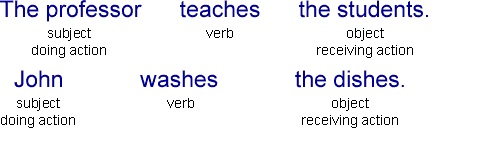
In active sentences, the thing doing the action is the subject of the sentence and the thing receiving the action is the object. Most sentences are active.

[Thing doing action] + [verb] + [thing receiving action]

Examples:

Passive Form

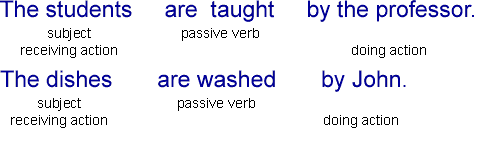
In passive sentences, the thing receiving the action is the subject of the sentence and the thing doing the action is optionally included near the end of the sentence. You can use the passive form if you think that the thing receiving the action is more important or should be emphasized. You can also use the passive form if you do not know who is doing the action or if you do not want to mention who is doing the action.

When rewriting active sentences in passive voice, note the following:

  • the object of the active sentence becomes the subject of the passive sentence
  • the finite form of the verb is changed (to be + past participle)
  • the subject of the active sentence becomes the object of the passive sentence (or is dropped)

[Thing receiving action] + [be] + [past participle of verb] + [by] + [thing doing action]

Examples:

Active / Passive Overview

 ActivePassive
Simple Present
Once a week, Tom cleans the house.
Once a week, the house is cleaned by Tom.
Present Continuous
Right now, Sarah is writing the letter.
Right now, the letter is being written by Sarah.
Simple Past
Sam repaired the car.
The car was repaired by Sam.
Past Continuous
The salesman was helping the customer when the thief came into the store.
The customer was being helped by the salesman when the thief came into the store.
Present Perfect
Many tourists have visited that castle.
That castle has been visited by many tourists.
Present Perfect Continuous
Recently, John has been doing the work.
Recently, the work has been being done by John.
Past Perfect
George had repaired many cars before he received his mechanic’s license.
Many cars had been repaired by George before he received his mechanic’s license.
Past Perfect Continuous
Chef Jones had been preparing the restaurant’s fantastic dinners for two years before he moved to Paris.
The restaurant’s fantastic dinners had been being prepared by Chef Jones for two years before he moved to Paris.
Simple Future
will
Someone will finish the work by 5:00 PM.
The work will be finished by 5:00 PM.
Simple Future
be going to 
Sally is going to make a beautiful dinner tonight.
A beautiful dinner is going to be made by Sally tonight.
Future Continuous
will
At 8:00 PM tonight, John will be washing the dishes.
At 8:00 PM tonight, the dishes will be being washedby John.
Future Continuous
be going to
At 8:00 PM tonight, John is going to be washingthe dishes.
At 8:00 PM tonight, the dishes are going to be being washed by John.
Future Perfect
will
They will have completed the project before the deadline.
The project will have been completed before the deadline.
Future Perfect
be going to
They are going to have completed the project before the deadline.
The project is going to have been completed before the deadline.
Future Perfect Continuous
will
The famous artist will have been painting the mural for over six months by the time it is finished.
The mural will have been being painted by the famous artist for over six months by the time it is finished.
Future Perfect Continuous
be going to
The famous artist is going to have been painting the mural for over six months by the time it is finished.
The mural is going to have been being painted by the famous artist for over six months by the time it is finished.
Used to
Jerry used to pay the bills.
The bills used to be paid by Jerry.
Would Always
My mother would always make the pies.
The pies would always be made by my mother.
Future in the Past
Would
I knew John would finish the work by 5:00 PM.
I knew the work would be finished by 5:00 PM.
Future in the Past
Was Going to
I thought Sally was going to make a beautiful dinner tonight.
I thought a beautiful dinner was going to be madeby Sally tonight.


Exercises

Writing Task 10

Friday, 11th January 2013

FACTUAL WRITING

An older relative recently bought a mobile phone but cannot use it very well. Write some simple instructions for your relative telling her how to send an SMS message.


Writing Task about CHRISTMAS: 6ºA and 6ºC

Friday, 14th December 2012

Creative writing (6ºA)

Write a composition using the following Christmas words:

family                    happiness

mistletoe               peace

reindeer                 be lovely

love                      snowman

happier                  fun

ornaments             January

friends                  star

Christmas carols     snow

Christmas present  Happy Christmas

New Year’s Eve      Christmas tree 


Creative writing (6ºC)

Write a composition using the following Christmas words:

love                       snow             

food                      Santa Claus   

presents                holiday

happiness               thankful            

children                 snowman       

family                    Christmas

star                      ornaments

The Three Wise Men      


Writing Task 9

Wednesday, 5th December 2012

CORRESPONDENCE

Your Irish friend is going to visit your area next month, but cannot decide where to go. Write an email to your friend comparing two different places you know well. Say which one is best for your friend.


Writing Task 8

Friday, 23rd November 2012

Descriptive / Creative writing

Write a description (true or imaginary) for a writing competition about a time when you helped a friend in trouble. Describe what you did to help and explain what you have learnt from the experience.


Present Perfect with for, since, just, before, yet and already

Present Perfect + for and since

Using the present perfect, we can define a period of time before now by considering its duration, with for + a period of time, or by considering its starting point, with since + a point in time.

For + a period of time

  • for six years, for a week, for a month, for hours, for two hours.
  • I have worked here for five years.

Since + a point in time

  • since this morning, since last week, since yesterday,
  • since I was a child, since Wednesday, since 2 o’clock.
  • I have worked here since 1990.

present perfect with for

  • She has lived here for twenty years.
  • We have taught at this school for a long time.
  • Alice has been married for three months.
  • They have been at the hotel for a week.

present perfect with since

  • She has lived here since 1980.
  • We have taught at this school since 1965
  • Alice has been married since March 2nd.
  • They have been at the hotel since last Tuesday.


Present perfect + just, before, already and yet

PRESENT PERFECT + just and before

Just

indicates that the action has happened in the very recent past and it is completed, e.g.
a. I’ve just lost my car keys and can’t leave for work.
b. Don’t call John, I’ve just done it.

Position

Just can be placed before the main verb (past participle).

Before

indicates the existence of past events, and emphasizing the pastness of the event with a redundant before e.g.
a. She has seen the movie before.
b. I have met her before the summer.

Position

Before is usually placed at the end of the sentence.

PRESENT PERFECT + already and yet

refers to an action that has happened at an unspecified time before now. It suggests that there is no need for repetition, e.g.
a. I’ve already drunk three coffees this morning. (and you’re offering me another one!)
b. Don’t write to John, I’ve already done it.

It is also used in questions:

  • Have you already written to John?
  • Has she finished her homework already?

Position

already can be placed before the main verb (past participle) or at the end of the sentence:

  • I have already been to Tokyo.
  • I have been to Tokyo already.

Yet

is used in negative statements and questions, to mean (not) in the period of time between before now and now, (not) up to and including the present. e.g.

  • Have you met Judy yet?
  • I haven’t visited the Tate Gallery yet.
  • Has he arrived yet?
  • They haven’t eaten yet.

Position

Yet is usually placed at the end of the sentence.


Present Perfect

Present Perfect Verb Tense

1. Present Perfect - Form

 The present perfect of any verb is composed of two elements : the appropriate form of the auxiliary verb to have (present tense), plus the past participle of the main verb. The past participle of a regular verb is base+ed, e.g. played, arrived, looked

Affirmative

Subject

to have

past participle

She

has

visited

Negative

Subject

to have + not

past participle

She

hasn’t

visited

Interrogative

to have

subject

past participle

Has

she

visited..?

Interrogative negative
to have + notsubjectpast participle
Hasn’tshevisited...?

Example: to walk, present perfect

AffirmativeNegativeInterrogative

I have walked

I haven’t walked

Have I walked?

You have walked

You haven’t walked

Have you walked?

He, she, it has walked

He, she, it hasn’t walked

Has he,she,it walked

We have walked

We haven’t walked

Have we walked?

You have walked

You haven’t walked

Have you walked?

They have walked

They haven’t walked

Have they walked?

2. Present perfect, function

 The Present Perfect is used to indicate a link between the present and the past. The time of the action is before now but not specified, and we are often more interested in the resultthan in the action itself.

BE CAREFUL! There may be a verb tense in your language with a similar form, but the meaning is probably NOT the same.

The Present Perfect is used to describe:

  1. An action or situation that started in the past and continues in the present. Example: I have lived in Bristol since 1984 (= and I still do.)
  2. An action performed during a period that has not yet finished. Example: She has been to the cinema twice this week (= and the week isn’t over yet.)
  3. A repeated action in an unspecified period between the past and now. Example: We have visited Portugal several times.
  4. An action that was completed in the very recent past, (expressed by ’just’). Example: I have just finished my work.
  5. An action when the time is not important. Example: He has read ’War and Peace’(the result of his reading is important)

Note: When we want to give or ask details about when, where, who, we use the simple pastExample: He read ’War and Peace’ last week.

Examples:

1. Actions started in the past and continuing in the present.

  • They haven’t lived here for years.
  • She has worked in the bank for five years.
  • We have had the same car for ten years.
  • Have you played the piano since you were a child?

2. When the time period referred to has not finished.

  • I have worked hard this week.
  • It has rained a lot this year.
  • We haven’t seen her today.

3. Actions repeated in an unspecified period between the past and now.

  • They have seen that film six times.
  • It has happened several times already.
  • She has visited them frequently.
  • We have eaten at that restaurant many times.

4. Actions completed in the very recent past (+just).

  • Have you just finished work?
  • have just eaten.
  • We have just seen her.
  • Has he just left?

5. When the precise time of the action is not important or not known.

  • Someone has eaten my soup!
  • Have you seen ’Gone with the Wind’?
  • She’s studied Japanese, Russian and English.

Writing Task 7

Friday, 9th November 2012

Descriptive / Creative writing

Write your diary (true or imaginary) for a day when you had the opportunity to do something you have always wanted to do.


Writing Task 6

Wednesday, 31st October 2012

Creative writing

Write a Halloween story in which there is a cat, a monster with a problem and a haunted house. Have also someone speaking!!

Writing Task 4

Friday, 19th October 2012

Correspondence

An American film company is making a film in your area next month and they are looking for extras. Write a letter to the film company explaining why you want to be an extra and saying why you might be suitable. Ask for more information about the film.


PASSIVE TENSE

Sentences can be active or passive. Therefore, tenses also have "active forms" and "passive forms." You must learn to recognize the difference to successfully speak English.

Active Form

In active sentences, the thing doing the action is the subject of the sentence and the thing receiving the action is the object. Most sentences are active.

[Thing doing action] + [verb] + [thing receiving action]

Examples:

Passive Form

In passive sentences, the thing receiving the action is the subject of the sentence and the thing doing the action is optionally included near the end of the sentence. You can use the passive form if you think that the thing receiving the action is more important or should be emphasized. You can also use the passive form if you do not know who is doing the action or if you do not want to mention who is doing the action.

When rewriting active sentences in passive voice, note the following:

  • the object of the active sentence becomes the subject of the passive sentence
  • the finite form of the verb is changed (to be + past participle)
  • the subject of the active sentence becomes the object of the passive sentence (or is dropped)

[Thing receiving action] + [be] + [past participle of verb] + [by] + [thing doing action]

Examples:

Active / Passive Overview

Active Passive
Simple Present
Once a week, Tom cleans the house.
Once a week, the house is cleaned by Tom.
Present Continuous
Right now, Sarah is writing the letter.
Right now, the letter is being written by Sarah.
Simple Past
Sam repaired the car.
The car was repaired by Sam.
Past Continuous
The salesman was helping the customer when the thief came into the store.
The customer was being helped by the salesman when the thief came into the store.

Exercises

Does the bird eat the Gingerbread Man??


So...does the bird eat the Gingerbread Man?

Wait and see...the decision will be in your hands.

Expect the unexpected after the summer holiday!


PERSONAL ACCOUNT: Steps to follow

These are the steps you have to follow when writing Your Personal Account:

1- Title.

2- Introduction (1st paragraph).

3- Who was with you when the event happened (2nd paragraph).

4- The body of the problem (3rd paragraph).

5- What happened in the end, how people felt, and what you have learnt (4th paragragh).

* DO NOT FORGET TO USE THE PAST TENSE.


FIRST CONDITIONAL

IF + SUBJECT + PRESENT SIMPLE , SUBJECT + WILL + INFINITIVE

SUBJECT + WILL + INFINITIVE + IF + SUBJECT + PRESENT SIMPLE

We use the First Conditional to talk about future events that are likely to happen.

  • If we take John, he’ll be really pleased.
  • If you give me some money, I’ll pay you back tomorrow.
  • If they tell us they want it, we’ll have to give it to them.
  • If Mary comes, she’ll want to drive.
The ’if’ clause can be used with different present forms.
  • If I go to New York again, I’ll buy you a souvenir from the Empire State Building.
  • If he’s feeling better, he’ll come.
  • If she hasn’t heard the bad news yet, I’ll tell her.

The "future clause" can contain ’going to’ or the future perfect as well as ’will’.

  • If I see him, I’m going to tell him exactly how angry I am.
  • If we don’t get the contract, we’ll have wasted a lot of time and money.

The "future clause" can also contain other modal verbs such as ’can’ and ’must’.

  • If you go to New York, you must have the cheesecake in Lindy’s.
  • If he comes, you can get a lift home with him.

exercise 1

exercise 2

exercise 3

exercise 4

exercise 5

IF YOU GIVE A MOUSE A COOKIE

What is reported speech?

Reported speech is when you tell somebody else what you or a person said before.

Distinction must be made between direct speech and reported speech.

Direct speech vs Reported speech:

Direct speechReported speech
She says:" she likes tuna fish."She says that she likes tuna fish.
She said: "I’m visiting Paris next weekend"She said that she was visiting Paris the following weekend.

Different types of sentences

When you use reported speech, you either report:

  • Statements
  • questions
  • requests / commands
  • other types

I. Reporting Statements

When transforming statements, check whether you have to change:

  • pronouns
  • tense
  • place and time expression

1-Pronouns

In reported speech, you often have to change the pronoun depending on who says what.

Example:

She says, “My dad likes roast chicken.” – She says that her dad likes roast chicken.

2-Tenses

  • If the sentence starts in the present, there is no backshift of tenses in Reported speech.
  • If the sentence starts in the past, there is often backshift of tenses in Reported speech.
 Direct speechReported speech
(no backshift)“I write poems.”He says that he writes poems.
(backshift)“I write poems.”
He said that he wrote poems.

No backshift

Do not change the tense if the introductory clause is in a present tense (e. g. He says). Note, however, that you might have to change the form of the present tense verb (3rd person singular).

Example:
He says, “I write poems.” – He says that he writes English.

Backshift

You must change the tense if the introductory clause is in a past tense (e. g. He said).

Example:
He said, “I am happy.” – He said that he was happy.

Examples of the main changes in tense:

Direct SpeechReported Speech
Simple Present
He said: "I am happy"
Simple Past
He said that he was happy
Present Progressive
He said: "I’m looking for my keys"
Past Progressive
He said that he was looking for his keys

3-Pronouns, place and time expressions

Place and time expressions change if the context of the reported statement (ie the location and/or the period of time) is different from that of the direct speech.

In the following tables, you will find ways of transforming personal pronouns, place and time expressions into reported speech.


Changes in Personal Pronouns: 
 

Ihe, she
youhe, she, they
wethey
theythey
he, shehe, she, I

Changes in Possessive Pronouns: 
 

myhis, her, my
yourhis, her, my
his, herhis, her
theirtheir
our,their

Changes in Places: 
 

herethere
thisthat
thesethose

here, there

at the George Hotel, at school

Changes in Time: 
 

last year, last month, last weekthe year/month/week before
yesterday,

the day before yesterday

the day before, 

two days before

todaythat day, yesterday, the day before
tomorrowthe next day
the day after tomorrowin two days
next week/month/yearthe following week/month/year
on Mondayon Monday, 11th December
this morning / afternoon / evening/nightthat morning / afternoon / evening/ night
last week, month, yearthe previous week, month, year
three days, weeks, months, ...years agothree days, weeks, months, .....years before


Examples of the main changes in tense:

Direct SpeechReported Speech
Simple Present
He said: "I am happy"
Simple Past
He said that he was happy
Present Progressive
He said: "I’m looking for my keys"
Past Progressive
He said that he was looking for his keys