1st Conditional
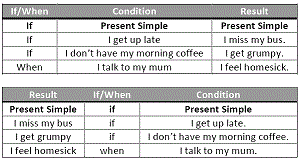
- Conditional tenses describe the result of something that might happen (in the present or future) or might have happened but didn’t (in the past).


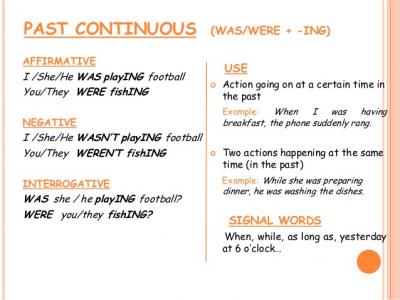
[was/were + verb-ING]
Examples:

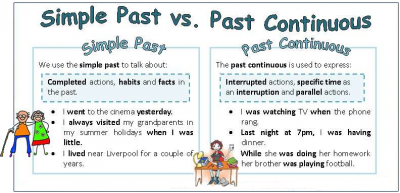
Use the Past Continuous to indicate that a longer action in the past was interrupted. The interruption is usually a shorter action in the Simple Past. Remember this can be a real interruption or just an interruption in time.
Examples:
In USE 1, described above, the Past Continuous is interrupted by a shorter action in the Simple Past. However, you can also use a specific time as an interruption.
Examples:
In the Simple Past, a specific time is used to show when an action began or finished. In the Past Continuous, a specific time only interrupts the action.
Examples:

When you use the Past Continuous with two actions in the same sentence, it expresses the idea that both actions were happening at the same time. The actions are parallel.
Examples:
In English, we often use a series of parallel actions to describe the atmosphere at a particular time in the past.
Example:

The Past Continuous with words such as "always" or "constantly" expresses the idea that something irritating or shocking often happened in the past. The concept is very similar to the expression "used to" but with negative emotion. Remember to put the words "always" or "constantly" between "be" and "verb+ing."
Examples:
It is important to remember that Non-Continuous Verbs cannot be used in any continuous tenses. Also, certain non-continuous meanings for Mixed Verbs cannot be used in continuous tenses. Instead of using Past Continuous with these verbs, you must use Simple Past.
Examples:
The examples below show the placement for grammar adverbs such as: always, only, never, ever, still, just, etc.
Examples:
Examples:

[am/is/are + verb-ING]
Examples:

Use the Present Continuous with Normal Verbs to express the idea that something is happening now, at this very moment. It can also be used to show that something is not happening now.
Examples:

In English, "now" can mean: this second, today, this month, this year, this century, and so on. Sometimes, we use the Present Continuous to say that we are in the process of doing a longer action which is in progress; however, we might not be doing it at this exact second.
Examples: (All of these sentences can be said while eating dinner in a restaurant.)

Sometimes, speakers use the Present Continuous to indicate that something will or will not happen in the near future.
Examples:

The Present Continuous with words such as "always" or "constantly" expresses the idea that something irritating or shocking often happens. Notice that the meaning is like Simple Present, but with negative emotion. Remember to put the words "always" or "constantly" between "be" and "verb+ing."
Examples:
It is important to remember that Non-Continuous Verbs cannot be used in any continuous tenses. Also, certain non-continuous meanings for Mixed Verbs cannot be used in continuous tenses. Instead of using Present Continuous with these verbs, you must use Simple Present.
Examples:
The examples below show the placement for grammar adverbs such as: always, only, never, ever, still, just, etc.
Examples:
Examples:
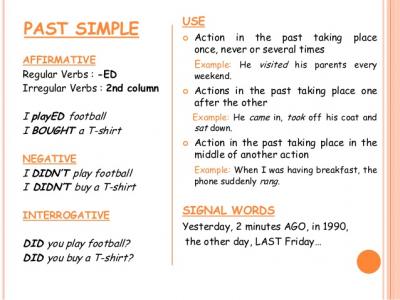
[VERB+ed] or irregular verbs
Examples:

Use the Simple Past to express the idea that an action started and finished at a specific time in the past. Sometimes, the speaker may not actually mention the specific time, but they do have one specific time in mind.
Examples:

We use the Simple Past to list a series of completed actions in the past. These actions happen 1st, 2nd, 3rd, 4th, and so on.
Examples:

The Simple Past can be used with a duration which starts and stops in the past. A duration is a longer action often indicated by expressions such as: for two years, for five minutes, all day, all year, etc.
Examples:
The Simple Past can also be used to describe a habit which stopped in the past. It can have the same meaning as "used to." To make it clear that we are talking about a habit, we often add expressions such as: always, often, usually, never, when I was a child, when I was younger, etc.
Examples:
The examples below show the placement for grammar adverbs such as: always, only, never, ever, still, just, etc.
Examples:
Examples:
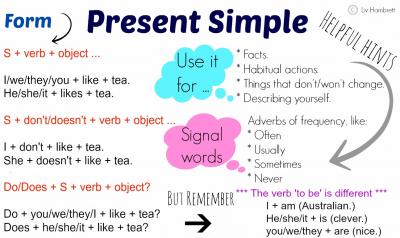
[VERB] + s/es in third person
Examples:
Use the Simple Present to express the idea that an action is repeated or usual. The action can be a habit, a hobby, a daily event, a scheduled event or something that often happens. It can also be something a person often forgets or usually does not do.
Examples:

The Simple Present can also indicate the speaker believes that a fact was true before, is true now, and will be true in the future. It is not important if the speaker is correct about the fact. It is also used to make generalizations about people or things.
Examples:
Speakers occasionally use Simple Present to talk about scheduled events in the near future. This is most commonly done when talking about public transportation, but it can be used with other scheduled events as well.
Examples:
Speakers sometimes use the Simple Present to express the idea that an action is happening or is not happening now. This can only be done with Non-Continuous Verbs and certain Mixed Verbs.
Examples:
The examples below show the placement for grammar adverbs such as: always, only, never, ever, still, just, etc.
Examples:
Examples:


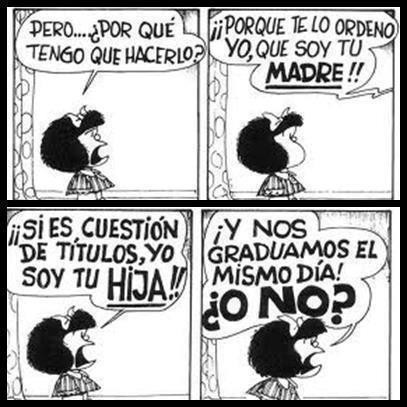
HAPPY MOTHER’S DAY!!!!
We hope you have a wonderful day!!!

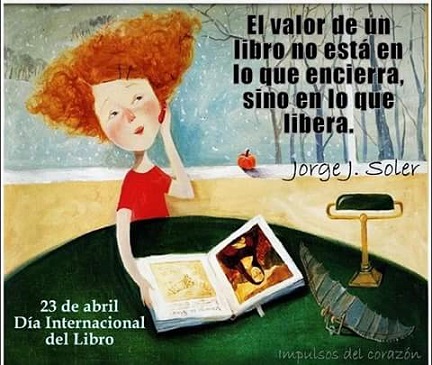
Reconociendo que la Tierra y sus ecosistemas es nuestro hogar y resaltando la necesidad de promover armonía con la naturaleza y el planeta, en abril de 2009 la Asamblea General de la ONU designó el 22 de abril como Día Internacional del la Madre Tierra (resolución 63/278),
Al proclamar esta fecha la Asamblea reconoció que “Madre Tierra” es una expresión común en varios países y regiones, reflejando la interdependencia que existe entre los seres humanos, otras especies y el planeta que habitamos. Solicitó que los Estados Miembros, los órganos de Naciones Unidas, organismos internacionales, regionales, subregionales, organizaciones no gubernamentales y la sociedad civil observen y creen conciencia del Día.
La palabra «madre» es sumamente evocadora. Nos trae a la memoria poderosos recuerdos de la mujer que nos trajo al mundo, nos crió y nos ayudó a convertirnos en quienes somos ahora. La Tierra es la madre por antonomasia: un planeta asombroso que desde tiempos inmemoriales ha sustentado la vida en una miríada de formas. Con el tiempo, los seres humanos dejamos de necesitar el cuidado materno constante; sin embargo, nunca dejamos de depender de la Madre Tierra. Durante toda la vida, necesitamos aire, agua, tierra fértil y la infinidad de otros dones con que nos obsequia el planeta.
Esta dependencia hace aún más sorprendente, si cabe, que hayamos permitido que el rápido y a menudo imprudente desarrollo humano haya hecho peligrar tantos de los delicados sistemas que llevan funcionando en armonía desde hace milenios. Cada vez somos más conscientes de los estragos que ha causado nuestra especie: la contaminación, la progresiva escasez de recursos, la extinción de especies de flora y fauna y la precipitación hacia puntos de inflexión que podrían alterar la forma en que funciona nuestro planeta. Ni sabiéndolo hemos cambiado nuestra forma de actuar.
Pero estamos a tiempo de enmendarnos y 2015 nos brinda una oportunidad inmejorable para hacerlo. Este año, el mundo se propone acabar de definir la agenda para el desarrollo sostenible después de 2015 y concertar un nuevo acuerdo universal sobre el cambio climático que sea constructivo. Estos procesos podrían encauzarnos hacia un futuro mejor al erradicar la pobreza extrema en todas sus formas y redefinir nuestra relación con el planeta y todos y cada uno de los seres vivos que lo habitan.
Las grandes decisiones que tenemos por delante no corresponden solo a los legisladores y los dirigentes mundiales. Hoy, en este Día de la Madre Tierra, hago un llamamiento para que todos nosotros seamos conscientes de las consecuencias que tienen nuestras decisiones sobre el planeta y lo que supondrán para las generaciones futuras. No todos tenemos a nuestro alcance obrar de manera sostenible, pero quienes tenemos esa posibilidad podemos transformar el mundo, entre los miles de millones de personas que somos, con simples decisiones como optar por bombillas de bajo consumo o comprar solo lo que vayamos a consumir. El cambio comienza con nosotros.
Como comunidad mundial, tenemos la oportunidad de hacer que 2015 sea un hito decisivo en la historia de la humanidad. Puede ser el año que nuestros hijos y nietos recuerden como el momento en que decidimos construir un futuro sostenible y resiliente, tanto para la Madre Tierra como para todos aquellos que el desarrollo ha dejado rezagados hasta ahora. Aprovechemos, juntos, esta oportunidad histórica.
1. Why does the body need nutrients and oxygen? How are they carried around our bodies?
The body needs nutrients and oxygen to live. They are carried around our bodies by the circulatory system.
2. What does the body do with the substances it doesn’t need or which are harmful?
It eliminates them by the digestive and the excretory system.
3. What does the circulatory system do?
The circulatory system takes oxygen and nutrients to all the tissues of the body, it also picks up waste products like carbon dioxide, and it takes them to organs that eliminate them.
4. Which systems are involved in the process of waste elimination?
The digestive system and the excretory system are involved in the process of waste elimination.
5. Explain: pulmonary circulation and general circulation.
Blood flows around the body in two different circuits: pulmonary circulation and general circulation.
During pulmonary circulation, blood flows from the heart to the lungs. In the lungs, the blood releases carbon dioxide and picks up oxygen. Then the blood flows back to the heart. This oxygenated blood is a bright red colour.
During general circulation, oxygenated blood flows from the heart to the rest of the body. The oxygen goes into the tissues of the body and the blood picks up carbon dioxide. Then the blood flows back to the heart. This deoxygenated blood is a dark red colour.
6. What is the difference between oxygenated blood and deoxygenated blood?
The oxygenated blood is a bright red colour and the deoxygenated blood is a dark red colour.
7. What does the blood carry? What does it contains?
The blood carries oxygen to the heart and carbon dioxide to the lungs.
The blood contains liquid plasma and solid blood cells.
8. How many types of blood cells are there? Name them and say what their functions are.
There are three types of blood cells: red blood cells, white blood cells and platelets.
The red blood cells carry oxygen and also contain some carbon dioxide.
The white blood cells fight infections in the body.
The platelets help to form a solid clot when there is a cut in a blood vessel.
9. Where do the blood vessels go?
The blood vessels are special tubes that carry blood all around the body.
10. Which blood vessels carry blood to the right atrium?
The pulmonary veins carry blood to the right atrium.
11. What are the capillaries?
Capillaries are tiny blood vessels that connect the smallest arteries to the smallest veins.
12. How many chambers has the heart got? How are they called?
The heart contains four open spaces called chambers. The two upper chambers are the right atrium and the left atrium. The two lower chambers are the right ventricle and the left ventricle.
13. Which chamber of the heart pumps blood around the body?
The ventricles pump blood out of the body.
14. What does the septum do?
The septum divides the heart into two sides: right and left.
15. Where does blood pick up oxygen?
The blood picks up oxygen in the lungs.
16. What are the functions of the excretory system? Name the two main parts of the excretory system.
The excretory system eliminates waste products and harmful substances from the body.
The two main parts of the excretory system are the sweat glands and the urinary tract.
17. What do sweat glands do? What does sweat contain?
Sweat glands produce sweat which is a liquid that contains water, waste products and mineral salts.
18. What are the main parts of the urinary tract? And what are their functions?
The main parts of the urinary tract are the kidneys, the ureters, the bladder and the urethra.
19. Explain the process of eliminating waste products and harmful substances through the urinary tract.
The kidneys filter the blood to remove waste. Then they mix the waste with water to produce urine. The ureters carry urine from your kidneys to your bladder. The bladder stores urine until you go to the toilet. The urethra carries the urine out of your body when you go to the toilet.
20.Where are the kidneys? What vessels carry blood to the kidneys?
The kidneys are two bean-shaped organs that are next to your spinal column.
The vessels that carry blood to the kidneys are the renal arteries.