Blogia

Our 6th grade Blog

PASSIVE VOICE

Use of Passive

Passive voice is used when the focus is on the action. It is not important or not known, however, who or what is performing the action.

Example: My bike was stolen.

In the example above, the focus is on the fact that my bike was stolen. I do not know, however, who did it.

Sometimes a statement in passive is more polite than active voice, as the following example shows:

Example: A mistake was made.

In this case, I focus on the fact that a mistake was made, but I do not blame anyone (e.g. You have made a mistake.).

Form of Passive

Subject + finite form of to be + Past Participle (3rd column of irregular verbs)

Example: A letter was written.

When rewriting active sentences in passive voice, note the following:

  • the object of the active sentence becomes the subject of the passive sentence
  • the finite form of the verb is changed (to be + past participle)
  • the subject of the active sentence becomes the object of the passive sentence (or is dropped)

Examples of Passive 

TenseSubjectVerbObject
Simple PresentActive:Ritawritesa letter.
Passive:A letteris writtenby Rita.
Simple PastActive:Ritawrotea letter.
Passive:A letterwas writtenby Rita.
Present PerfectActive:Ritahas writtena letter.
Passive:A letterhas been writtenby Rita.
Future IActive:Ritawill writea letter.
Passive:A letterwill be writtenby Rita.
HilfsverbenActive:Ritacan writea letter.
Passive:A lettercan be writtenby Rita.

Examples of Passive 

TenseSubjectVerbObject
Present ProgressiveActive:Ritais writinga letter.
Passive:A letteris being writtenby Rita.
Past ProgressiveActive:Ritawas writinga letter.
Passive:A letterwas being writtenby Rita.
Past PerfectActive:Ritahad writtena letter.
Passive:A letterhad been writtenby Rita.
Future IIActive:Ritawill have writtena letter.
Passive:A letterwill have been writtenby Rita.
Conditional IActive:Ritawould writea letter.
Passive:A letterwould be writtenby Rita.
Conditional IIActive:Ritawould have writtena letter.
Passive:A letterwould have been writtenby Rita.

Personal and Impersonal Passive

Personal Passive simply means that the object of the active sentence becomes the subject of the passive sentence. So every verb that needs an object (transitive verb) can form a personal passive.

Example: They build houses. – Houses are built.

Verbs without an object (intransitive verb) normally cannot form a personal passive sentence (as there is no object that can become the subject of the passive sentence). If you want to use an intransitive verb in passive voice, you need an impersonal construction – therefore this passive is called Impersonal Passive.

Example: he says – it is said

Impersonal Passive is not as common in English as in some other languages (e.g. German, Latin). In English, Impersonal Passive is only possible with verbs of perception (e. g. say, think, know).

Example: They say that women live longer than men. – It is said that women live longer than men.

Although Impersonal Passive is possible here, Personal Passive is more common.

Example: They say that women live longer than men. – Women are said to live longer than men.

The subject of the subordinate clause (women) goes to the beginning of the sentence; the verb of perception is put into passive voice. The rest of the sentence is added using an infinitive construction with ’to’ (certain auxiliary verbs and that are dropped).

Sometimes the term Personal Passive is used in English lessons if the indirect object of an active sentence is to become the subject of the passive sentence.

Exercises

Exercises on Passive (Form)

Exercises on Passive (Active → Passive)

Exercises on Passive (Active or Passive)

Tests on Passive

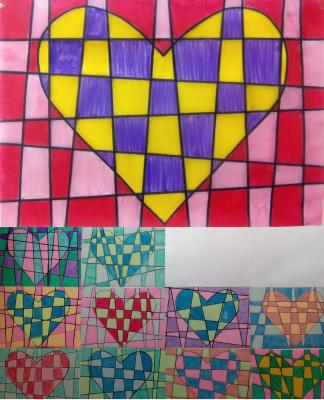
Nuestro Mercadillo de San Valentín!!

Nuestro Mercadillo de San Valentín!!

Y seguimos recaudando dinero para nuestro viaje a Santoña!!!

Gracias a todos los que habéis colaborado y los que os habéis acercado a comprar nuestros productos!!!

XOXO

Our Hearts!!!

Our Hearts!!!

Writing Task 4

Friday, 12th February 2016

Correspondence

An American film company is making a film in your area next month and they are looking for extras. Write a letter to the film company explaining why you want to be an extra and saying why you might be suitable. Ask for more information about the film.


FATHER’S DAY

FATHER’S DAY

Remember!!!!!

Last day to bring photos and “things” -> Monday, 29th February


Writing Task 3

Friday, 5th February 2016

Correspondence

You have just won a large sum of money in a lottery. Write an email to your best friend to tell him or her the good news. Explain how you are planning to spend the money and ask your friend what he / she thinks of your ideas.


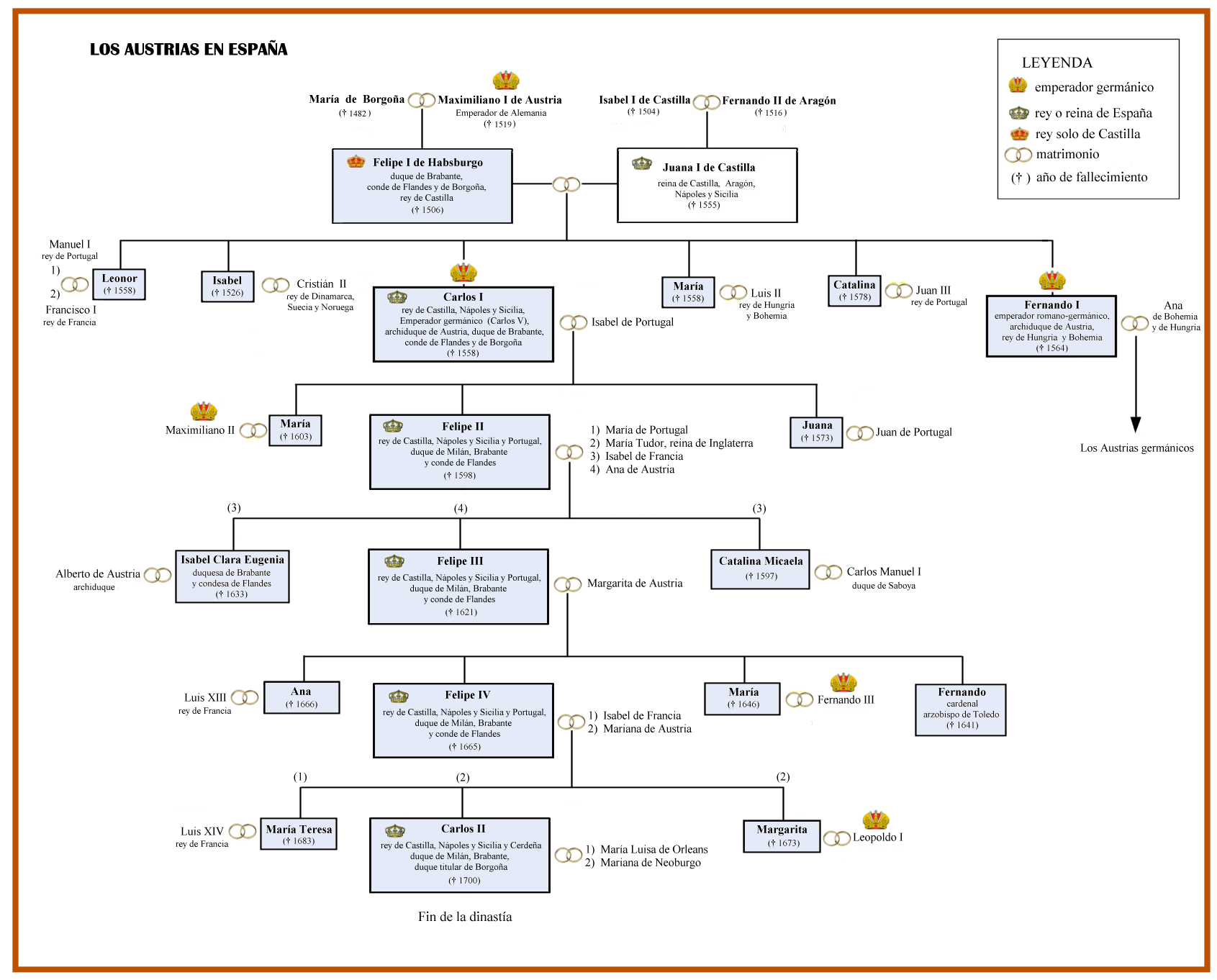
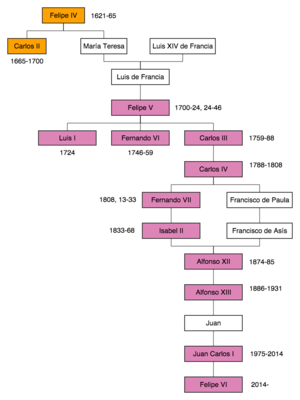
HABSBURG and BOURBON DINASTIES

2º pago VIAJE FIN DE CURSO

Queremos recordaros que a lo largo de esta semana hay que realizar el 2º pago del VIAJE DE FIN DE CURSO:

1º plazo: 100€, del 1 al 5 de febrero de 2016 


Número de cuenta: BBVA NATURENGLISH S.L.

ES52 0182 4015 61 0202511540


Concepto: NAVALAZARZA + NOMBRE Y APELLIDOS (entregar resguardo a los tutores)

ReflejARTE: Instrucciones para nuestro mural

ReflejARTE: Instrucciones para nuestro mural

REFLEJARTE

Sol LeWitt. 17 Wall Drawings. 1970-2015 

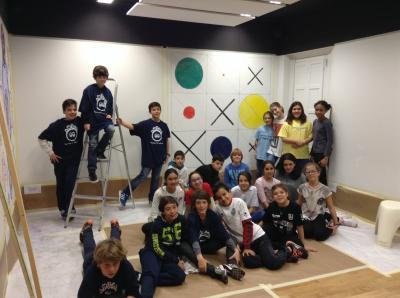
Nuestro mural:

Título: TRES EN RAYA

Materiales: lápices, regla, escuadra, compás, ceras Manley de colores (negro, amarillo, rojo, verde, azul y naranja)

Dibujado por primera vez por: alumnos de 6º

Ideado por: un grupo de cinco alumnos de 6º

Fecha: Febrero 2016


Instrucciones

  1. Dibuja un cuadrado de 1,80 x 1,80 m.
  2. Divide el cuadrado en 9 partes iguales de 60 x 60 cm cada una.
  3. Dibuja líneas de punto diagonales continuas atravesando los vértices de cada cuadrado.
  4. En el cuadrado 1 (arriba a la izquierda) dibuja un círculo de 25 cm de radio con eje en el cruce de líneas discontinuas.
  5. En el cuadrado 2 (arriba en el centro) dibuja un punto en el centro.
  6. En el cuadrado 3 (arriba a la derecha) dibuja dos líneas rectas, sobre las líneas discontinuas, de 40 cm centradas (20 cm a cada lado) y formando un aspa.
  7. En el cuadrado 4 (en la línea del centro a la izquierda) dibuja un círculo de 10 cm de radio con eje en el cruce de líneas discontinuas.
  8. En el cuadrado 5 (el del centro del dibujo) dibuja dos líneas rectas, sobre las líneas discontinuas, de 60 cm centradas (30 cm a cada lado) y formando un aspa.
  9. En el cuadrado 6 (en la línea del centro a la derecha) dibuja un círculo de 30 cm de radio con eje en el cruce de líneas discontinuas. Este círculo tiene que ocupar todo el cuadrado y tocar todos sus lados.
  10. En el cuadrado 7 (abajo a la izquierda) dibuja dos líneas rectas, sobre las líneas discontinuas, desde cada uno de los vértices del cuadrado hasta el contrario formando un aspa.
  11. En el cuadrado 8 (abajo en el centro) dibuja un círculo de 20 cm de radio con eje en el cruce de líneas discontinuas.
  12. En el cuadrado 9 (abajo a la derecha) dibuja dos líneas rectas, sobre las líneas discontinuas, de 20 cm centradas (10 cm a cada lado) y formando un aspa.
  13. Repasa todas las aspas de color negro.
  14. Colorea los círculos de amarillo, azul, verde, rojo y naranja. Tú eliges cuál es de cada color.

Writing Task 2

Friday, 29th January 2016

Write a short story (approximately 150 words). In your story there should be a cat, a party, and a bus.


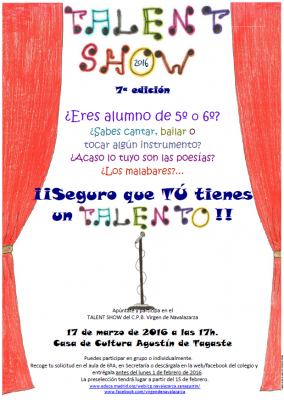
TALENT SHOW 2016

TALENT SHOW 2016

Bases:

1. El TALENT SHOW tendrá lugar el jueves 17 de marzo a las 17:00 h en el salón de actos de la Casa de Cultura Agustín de Tagaste.
2. Podrán participar aquellos alumnos de 5º y 6º de primaria o cualquier miembro adulto de la Comunidad Educativa del C.P.B. Virgen de Navalazarza que quieran compartir sus habilidades en el escenario.
3. Las actuaciones podrán ser individuales o en grupo.
4. Todos los espectáculos del TALENT SHOW deberán ser acompañados de música.
5. A partir del 15 de enero las solicitudes podrán ser recogidas en el aula de 6ºA, en Secretaría o descargadas de la página web o del facebook del C.P.B. Virgen de Navalazarza.
6. La solicitud de participación deberá ser entregada en Secretaría o a la profesora Estibaliz Medina (organizadora del Talent Show) desde el día 18 hasta el día 31 de enero.
7. La organización publicará las primeras listas con el orden en el que se hará la preselección en la semana del 9 al 12 de febrero, y las irá actualizando a lo largo de la siguiente semana.
8. Todos los participantes tendrán que pasar una preselección (casting) delante del personal encargado de la organización. A esta selección los participantes tendrán que acudir con el número ya preparado para mostrárselo integro a la organización. La organización se reserva el derecho de selección del espectáculo, siendo atendida cualquier reclamación a partir de las 48 horas siguientes a la publicación de los listados, con los números seleccionados.
9. La selección de los números (casting) que participarán en el TALENT SHOW tendrá lugar a partir del 15 de febrero, en horario de 14 a 15h., en las aulas de 6º, este período de selección podría estar sujeto a modificaciones.
10. La organización proveerá de todo el material de iluminación y sonido solicitado por los participantes. Cada participante aportará aquellos materiales que necesite para su número. La utilización de estos materiales tendrá que contar con el visto bueno de la organización.
11. La organización también tendrá pleno derecho de elegir tanto el orden de participación como los tiempos de cada espectáculo incluido en el TALENT SHOW.
12. Cada participante aportará la música con la que acompañará su número en soporte C.D. con la duración total de su actuación, que será entregado a la persona responsable de la organización en el momento de la selección, y deberá ir identificado con el nombre y el número del participante.
13. Dado que este evento se grabará y se tomarán fotos durante las actuaciones, todos los participantes deberán autorizar al uso de su imagen. Estas imágenes se utilizarán únicamente en entornos relacionados con el colegio.
14. El jurado estará formado por un representante del Claustro de Profesores, un representante del Equipo Directivo, un representante del Ayuntamiento, un representante de la empresa ALIRSA y un representante del AMPA.


La organización del TALENT SHOW

APPS to create Timelines

I’ve found a few websites with recommended apps to create Timelines. Here they are:

Top 20 Sites and Apps for creating Timelines: Tech & Learning

5 great Ipad Apps to create timelines: Education Technology & Mobile Learning

Seis Apps para crear líneas del tiempo: AulaPlaneta

Hope you find them helpful!!!


Writing Task 1

Friday, 22nd January 2016

Yesterday something important happened to you or to your family.

Write your diary for that day (approximately 75 words) saying:

     i)     what happened

     ii)    how important it was

     iii)   how you felt about it.


SOCIAL SCIENCE TASK


In your computer or tablet, make a vertical timeline of all the periods in History (prehistory and history) until the 19th century.

Mark the most relevant events of each period: add pictures, dates and a short explanation.

DEATH DATE: 28th January

EL MISMO SOL


Cambridge Examinations: Key for Schools & Preliminary for Schools

A great first step in learning English 

Cambridge English: Key for Schools, also known as Key English Test (KET) for Schools, shows that a student can use simple, everyday written and spoken English. 

Cambridge English: Key for Schools is a basic level qualification.

Why take the exam?

Every year, thousands of students take Cambridge English: Key for Schools to show they can use everyday written and spoken English.

Download Cambridge English: Key for Schools leaflet (PDF 324Kb) 

Download information for candidates (PDF 1.38Mb)


Practical English for everyday use

Cambridge English: Preliminary for Schools, also known as Preliminary English Test (PET) for Schools, shows that a student can understand and communicate using everyday written and spoken English.

Cambridge English: Preliminary for Schools is an intermediate level qualification.

Why take the exam?

Every year, thousands of students take Cambridge English: Preliminary for Schools to show they can use English to communicate for everyday purposes.


SOL LEWITT

Sol LeWitt (9 de septiembre de 1928, Hartford, Connecticut, -8 de abril de 2007, Nueva York).

Artista ligado a varios movimientos incluyendo arte conceptual y minimalista. La pintura, el dibujo, la fotografía y las estructuras (término que él prefería al de escultura) son sus medios artísticos predominantes. Fue objeto de centenares de exposiciones individuales en museos y galerías por todo el mundo desde 1965.

La Fundación Botín, en Santander, acoge desde el viernes 17 de julio y hasta el 10 de enero la exposición más importante realizada en España dedicada en exclusiva a los dibujos murales de Sol LeWitt, considerado el padre del Arte Conceptual. 

Pincha en el link para realizar una visita virtual a esta exposición.

SOL LEWITT en Santander 

How do you like this exposition?

Do you like these pieces of art?

How do you feel about them?

Would you be able to do something similar?

Come on!! Let’s try!!!! Guiño


Present Perfect with FOR, SINCE, YET, JUST, ALREADY and BEFORE

Present Perfect + for and since

Using the present perfect, we can define a period of time before now by considering its duration, with for + a period of time, or by considering its starting point, with since + a point in time.

For + a period of time

  • for six years, for a week, for a month, for hours, for two hours.
  • I have worked here for five years.

Since + a point in time

  • since this morning, since last week, since yesterday,
  • since I was a child, since Wednesday, since 2 o’clock.
  • I have worked here since 1990.

present perfect with for

  • She has lived here for twenty years.
  • We have taught at this school for a long time.
  • Alice has been married for three months.
  • They have been at the hotel for a week.

present perfect with since

  • She has lived here since 1980.
  • We have taught at this school since 1965
  • Alice has been married since March 2nd.
  • They have been at the hotel since last Tuesday.


Present perfect + just, before, already and yet

PRESENT PERFECT + just and before

Just

indicates that the action has happened in the very recent past and it is completed, e.g.
a. I’ve just lost my car keys and can’t leave for work.
b. Don’t call John, I’ve just done it.

Position

Just can be placed before the main verb (past participle).

Before

indicates the existence of past events, and emphasizing the pastness of the event with a redundant before e.g.
a. She has seen the movie before.
b. I have met her before the summer.

Position

Before is usually placed at the end of the sentence.

PRESENT PERFECT + already and yet

refers to an action that has happened at an unspecified time before now. It suggests that there is no need for repetition, e.g.
a. I’ve already drunk three coffees this morning. (and you’re offering me another one!)
b. Don’t write to John, I’ve already done it.

It is also used in questions:

  • Have you already written to John?
  • Has she finished her homework already?

Position

already can be placed before the main verb (past participle) or at the end of the sentence:

  • I have already been to Tokyo.
  • I have been to Tokyo already.

Yet

is used in negative statements and questions, to mean (not) in the period of time between before now and now, (not) up to and including the present. e.g.

  • Have you met Judy yet?
  • I haven’t visited the Tate Gallery yet.
  • Has he arrived yet?
  • They haven’t eaten yet.

Position

Yet is usually placed at the end of the sentence.

Exercises on Present Perfect

Human Body Book - Example

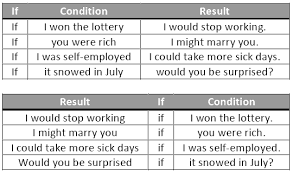
2nd Conditional

2nd Conditional