Blogia

Our 6th grade Blog

FORCES and MACHINES - Questions

  1. What is a force?
  2. What are the main types of forces?  Give examples.
  3. What type of force is magnetism?
  4. What is the force of gravity? What does it depend on?
  5. How do mass and distance affect the force of gravity?
  6. Why do astronauts float in space?
  7. What is a machine?
  8. What is a simple machine?
  9. What is a complex machine?
  10. In what everyday machines can we find gears?
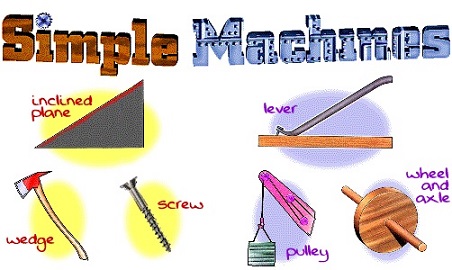
  11. What are the main types of simple machines?    
  12. How can we use a pulley?
  13. How can we use a ramp?
  14. How can we use a lever?
  15. How do we call the fixed point of a lever?
  16. Let’s see how much you know about your bicycle: What is the part that connects the crank to the back wheel? What do you use to change the direction of the front wheel? What is the special wheel with metal gears? What does a cable to control the brake pull?
  17. What is technology? What does it include?
  18. What is the most important invention in the history of transport?
  19. What type of engine have most aeroplanes got today?
  20. What did the steam engine give us?

MORE GAMES ABOUT SIMPLE MACHINES


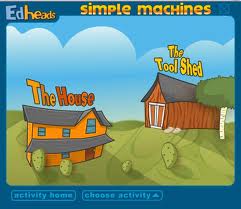
SIMPLE MACHINES GAME

Fancy playing a game on SIMPLE MACHINES while learning a bit more about them?

Click on the picture to start.

QUESTION TAGS

We use tags in spoken English but not in formal written English.

They are not really questions but are a way of asking the other person to make a comment and so keep the conversation open.

Making a tag is very mechanical. To make a tag, use the first auxiliary. If there is no auxiliary, use do, does or did. With a positive sentence, make a negative tag and with a negative sentence, make a positive tag.

  • It’s beautiful, isn’t it?
  • He has been, hasn’t he?
  • You can, can’t you?
  • It must be, mustn’t it?
  • You know him, don’t you?
  • He finished it, didn’t he?
  • He will come, won’t he?
  • It isn’t very good, is it?
  • It hasn’t rained, has it?
  • It can’t be, can it?
  • Jenny doesn’t know James, does she?
  • They didn’t leave, did they?
  • He won’t do it, will he?

Notice these:

  • There isn’t an ATM here, is there?
  • Let’s have a cup of coffee, shall we?

To reply, use the same auxiliary:

  • It’s beautiful, isn’t it? ~ Yes, it is. I think it’s fabulous.
  • It isn’t very good, is it? ~ No, it isn’t. In fact, it’s terrible.
Although, the rules are very simple and mechanical, in order to use them easily in conversation, they have to be automatic. So you need to hear and practice them very often.

exercise 1

exercise 2

exercise 3

exercise 4

exercise 5

exercise 6

MORE ABOUT SIMPLE MACHINES

MORE ABOUT SIMPLE MACHINES

ANATOMY OF A GADGET-CAN YOU IDENTIFY THE SIMPLE MACHINE AT WORK? TEST YOURSELF HERE

SIMPLE MACHINES AND MORE

LEONARDO DA VINCI’S MYSTERY MACHINES GAME

MIKIDS-SIMPLE MACHINES


Force and Motion Facts

Force and Motion Facts

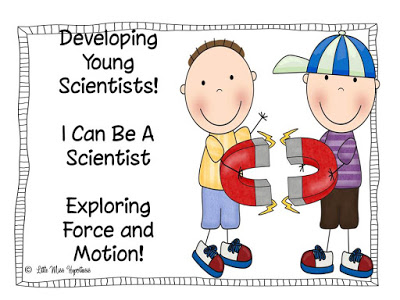
Motion makes the world go 'round. Motion is important to our lives and impacts so many things that we do. Motion is the changing of position or location. But motion requires a force to cause that change. 

Force is just a fancy word for pushing or pulling. If I push on something or pull on it, then I am applying a force to it. Force makes things move or, more accurately, makes things change their motion. Two natural forces that we have experienced are the force of gravity and magnetic forces.

Carry on learning about force and motion by clicking here....

The Chronicles of Navalazarza 2012-2013

Here is at last, our second magazine!!!!

Hope you like it!!

Experiment

Experiment

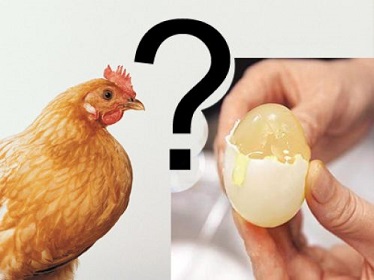
By placing an egg in a bowl containing vinegar, we can observe changes in its physical properties. Through this home experiment we'll try to explain in more detail each of the physical changes (color, smell, texture, etc.), as well as possible changes in chemical structure (decomposition).

Click here to learn about the experiment...


OPERACIONES SEMANA DEL 26 AL 30 DE MAYO.

OPERACIONES SEMANA DEL 26 AL 30 DE MAYO.

FECHA:26 DE MAYO

87.354 : 36   y         Prueba

FECHA: 27 DE MAYO

756.523 : 547    y         Prueba

FECHA: 28 DE MAYO

875.365,25 + 64.235,83=

254.368,68 – 98.388,9 =

FECHA: 29 DE MAYO

32.456 : 72        y         Prueba

4,789 x100=

324 :100 =

 FECHA: 30 DE MAYO

6.745,789 x 74,3

Physical & Chemical Changes

Physical & Chemical Changes

MATTER CHANGES - Questions

  1. What is matter?

  2. What does the state of matter depend on?

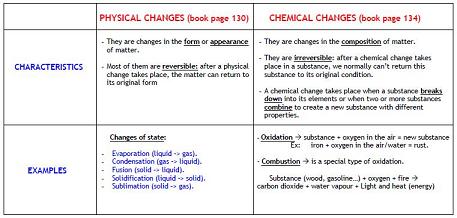
  3. What is the difference between physical changes and chemical changes of matter?

  4. How do we call the physical changes that matter undergoes when it changes from one physical state to another because of a change of temperature? Draw the diagram.

  5. What is a pure substance? What is a mixture? What is a solution?

  6. What is the difference between a homogeneous mixture and a heterogeneous mixture? Give examples.

  7. What is oxidation? And combustion?

  8. What techniques would you use to separate a mixture of oil and water, a mixture of sand and water, a mixture of salt and water, and to separate a mixture of iron and sand?

  9. It’s very cold and you are talking outside. Why does white vapour come out of your mouth? Is this a chemical change or physical change?

  10. Lets see what you know about water: Is it a pure substance or a mixture? Is it a simple substance or a compound? Why? What is its boiling point?


OPERACIONES SEMANA DEL 19 AL 23 DE MAYO DE 2014

OPERACIONES SEMANA DEL 19 AL 23 DE MAYO DE 2014

FECHA:19 DE MAYO

38.587 : 64   y   Prueba

FECHA: 20 DE MAYO

96.574 : 635 y   Prueba

FECHA: 21 DE MAYO

78.523,654 + 87.589,25=

52.365,326 – 3.678,66 =

FECHA: 22 DE MAYO

78.496 : 46 y    Prueba

0,0653 x1000=

96 :1000 =

FECHA: 23 DE MAYO

547,369 x 87,9 =

Solid, liquid and gas

Chemical and Physical Changes

LA METÁFORA Y LA COMPARACIÓN

¡Hola chicos! 

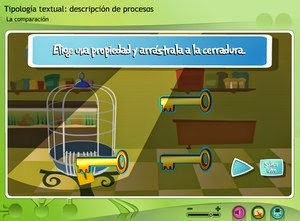
Aquí os dejo un juego para practicar lo que hemos aprendido sobre la metáfora y la comparación.

¡A jugar! ;)


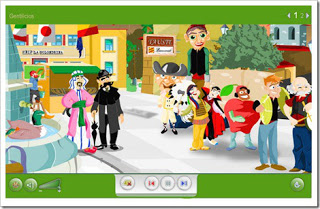
GENTILICIOS

¡Hola chicos!

Aquí os dejamos unas actividades para que practiquéis y juguéis con los gentilicios.

Esperamos que os gusten y os sirva para estudiar mejor.


OPERACIONES SEMANA DEL 12 AL 16 DE MAYO DE 2014

OPERACIONES SEMANA DEL 12 AL 16 DE MAYO DE 2014

FECHA:12 DE MAYO

69.079 : 97   y      Prueba

FECHA: 13 DE MAYO

84.023 : 732     y    Prueba

FECHA: 14 DE MAYO

4+3x6-2x7=

5x9-2x4+2=

8+(7-2)+2x6=

FECHA: 15 DE MAYO

41.849 : 63     y    Prueba

0,054 x 10=

45,32 : 1000=

FECHA: 16 DE MAYO

621,78 x 9,53=

45.123,547 + 5.368,47=

Physical and Chemical Properties of Matter

Each phase of matter has its own chemical and physical properties.

Phases of Matter

The phases of matter are:

  • Solid – which has a definite shape and volume
  • Liquid – which has a definite volume, but can change shape
  • Gas - the shape and volume of a gas can change

Phase Changes of Matter

There are several ways in which phases of matter can change from one to another:

  • Melting - melting occurs when a substance changes from a solid to a liquid
  • Boiling - boiling is when a substance changes from a liquid to a gas
  • Condensing - condensation is when a gas changes to a liquid
  • Freezing - freezing is when a liquid changes to a solid

Classes of Changes in Matter

The changes that take place in substances may be categorized in two classes:

  • Physical Change – a new substance is not produced and just the physical properties are changed. For example - phase changes, or crushing a can
  • Chemical Change – a new substance is produced with different chemical properties. For example: burning, rusting, and photosynthesis.

Solutions

Sometimes, when two or more substances are combined it results in a solution. Making a solution can produce either a physical or chemical change. When there’s a physical change in a solution, the original substances can be separated from one another. If a chemical change takes place while creating a solution, the original substances cannot be separated from one another.

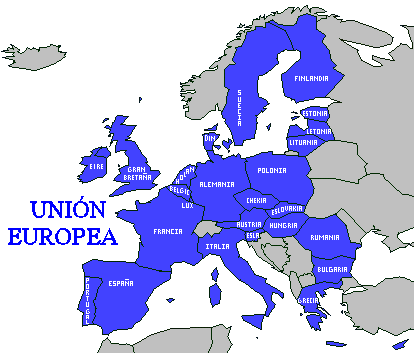
Atrévete con Europa...

Atrévete con Europa...

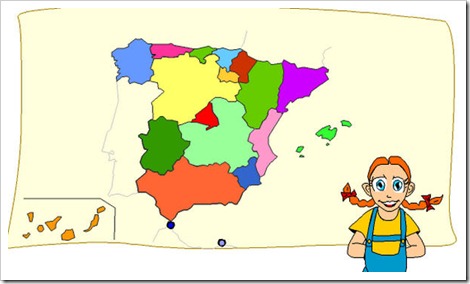
Si ya dominas la geografía española, atrévete con el mapa de Europa.

Pincha en el enlace para descubrir más juegos interactivos y aprender sobre Europa en su gran día.


Europa@Junior

Europa@Junior

¿Quieres conocer mejor Europa? 

En Europ@ Junior encontrarás noticias sobre lo que pasa en la Unión Europea, juegos y enlaces superchulos.

¡Te va a encantar!