Blogia
Our 6th grade Blog

SOCIAL AND NATURAL SCIENCE

PREHISTORIA

¿QUÉ ES LA HISTORIA?

   La historia es la ciencia que tiene como objeto de estudio el pasado de la humanidad.
   Esta sencilla definición se puede ampliar mucho más, pues los historiadores no sólo tratan de investigar los hechos de la humanidad sino también las causas que llevaron a ellos y las consecuencias que éstos han tenido en los hechos futuros.

   Para comprender los hechos históricos es necesario conocer los antecedentes que llevaron a ellos, por ello, el estudio de la Historia debe comenzar desde el primer momento en que aparecen seres humanos sobre la Tierra.

   La Historia de la humanidad se divide en dos periodos: la Prehistoria y la Historia.

   La Prehistoria, que abarca varios millones de años, es el periodo comprendido entre la aparición de los hombres y la invención de la escritura. Este periodo es conocido por la interpretación de los restos (utensilios, construcciones, pinturas rupestres, etc) dejados por nuestros antepasados. 

   La Historia es el periodo comprendido entre la aparición de la escritura, hace aproximadamente 5000 años, y la actualidad. El llamado periodo histórico se conoce, además de por los restos que se conservan, por los textos escritos donde se narran las formas de vida de las civilizaciones que nos han precedido y los principales sucesos que en ellas se dieron.
   
Observa la siguiente línea del tiempo:
(Debes entender que la Preshistoria abarca un periodo de tiempo "infinatamente" mayor que la Historia. La Prehistoria abarca varios millones de años y la Historia sólo los últimos 5.000 años. Para que lo entiendas mejor, si la línea del tiempo tuviera un kilómetro de longitud, la Prehistoria abarcaría toda la línea, excepto unos pocos centímetros, que corresponderían al periodo Histórico).

LA PREHISTORIA

   La Prehistoria se divide en varias etapas:

EL PALEOLÍTICO
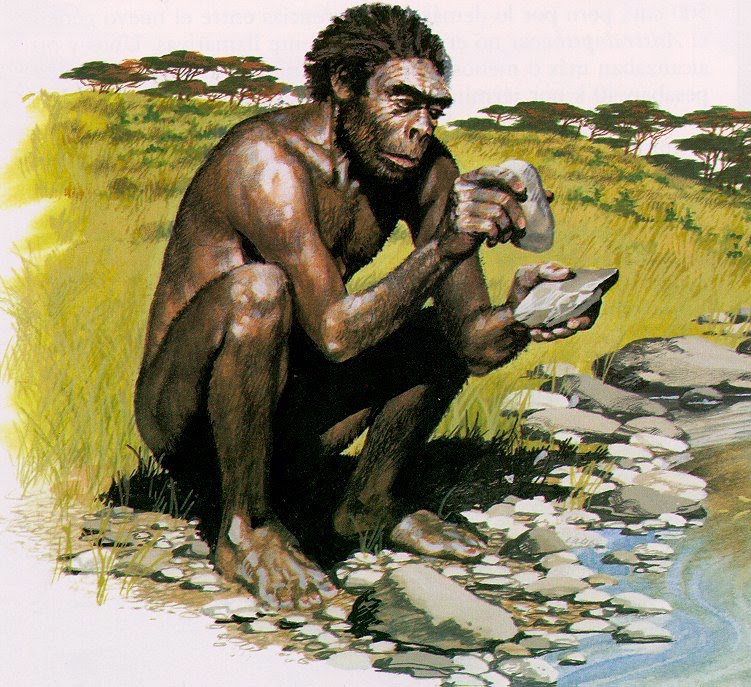
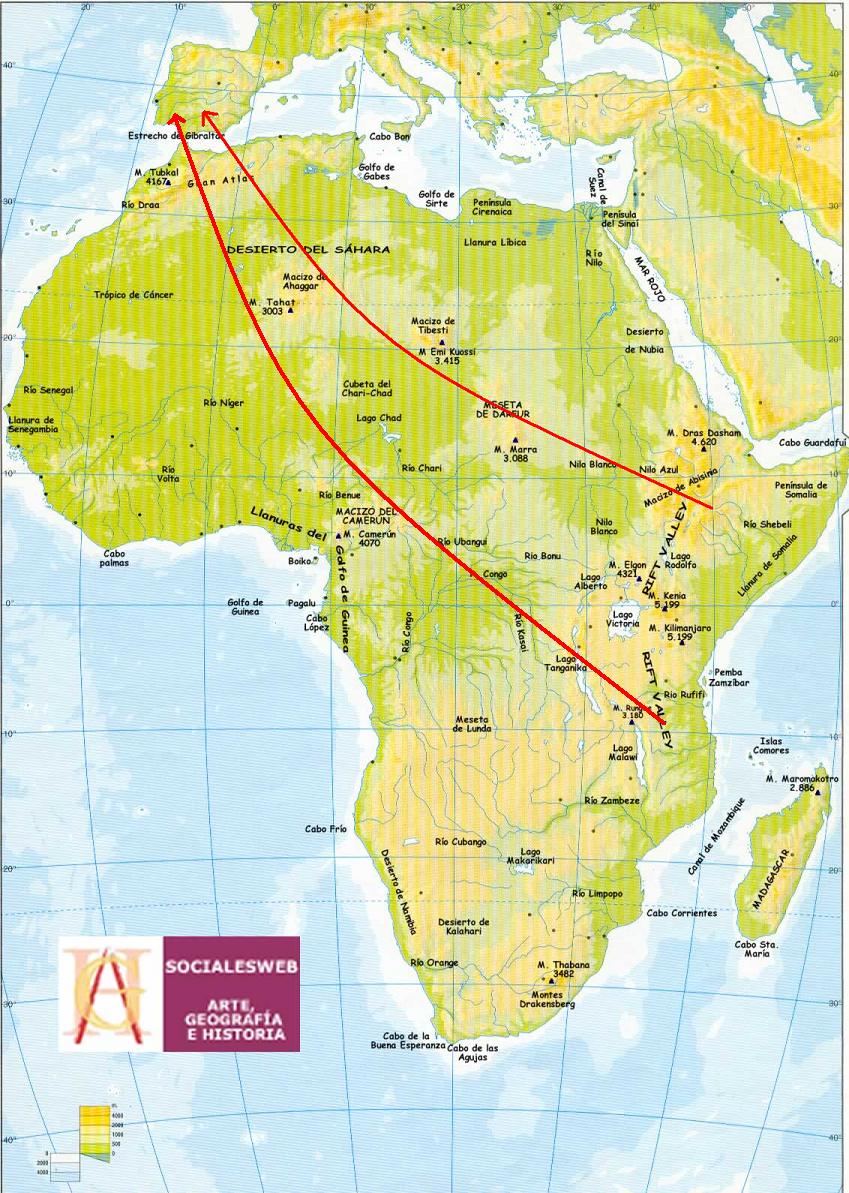
  • Parece ser que los primeros seres humanos que habitaron la Península Ibérica llegaron, procedentes de África, hace aproximadamente 1 millón de años.
  • Viven al aire libre en cuevas, o en sencillas cabañas construidas con ramas y pieles animales.
  • Se alimentan de lo que encuentran en la naturaleza: recolectan frutos silvestres y raíces, pescan peces y moluscos, cazan ciervos, bisontes, mamuts, ...
  • Visten con pieles de animales que cazan. Conocen el fuego y lo utilizan para calentarse, defenderse de los animales y cocinar alimentos.
  • Viven en pequeños grupos, tribus, formados por varias familias.
  • Fabrican herramientas con piedras y huesos: agujas, arpones para pescar, hachas, cuchillos, puntas de flecha, etc.
  • Aparecen los primeros artistas. Pintan animales y escenas de caza en paredes y techos de las cuevas, obteniendo las pinturas de minerales que machacaban y mezclaban con grasa de animales. También hacen pequeñas esculturas, que representan mujeres embarazadas, llamadas venus.
Esquema del paleolítico:
EL NEOLÍTICO

   Neolítico significa "nueva edad de la piedra", aunque según la mayoría de los historiadores se debería llamar edad de la piedra pulimentada.

   El Neolítico comienza hace aproximadamente  10.000 años, aunque no se desarrolla simultáneamente en todos los sitios. En Europa, podemos decir, como afirma el libro de texto, que comienza hace aproximadamente unos 7.000 años.

    El comienzo del Neolítico lo marcan dos hechos muy importantes: el descubrimiento de la agricultura y la ganadería.

   Los hombres aprenden a cultivar semillas; primero trigo y arroz, luego otras plantas.

Agricultura en el Neolítico

   Por otro lado, aprenden a domesticar animales, cabras, ovejas, bueyes, que guardan en cercados.

Ganadería en el Neolítico

   Estos dos hechos importantísmos permiten al hombre del Neolítico cambiar su forma de vida. Ya no es necesario que se desplace de un lugar a otro en busca de comida y se hace sedentario, es decir, se asienta en un lugar donde construyen poblados cada vez mayores.

Poblado Neolítico

   Las aldeas y poblados del Neolítico se sitúan cerca de los ríos, para poder disponer de agua cerca, y se rodean con vallas y cercas de troncos o empalizada, que servía para defenderla.

   En esta época, los hombres empiezan a especializarse en algunas tareas, así unos eran agricultores, otros cazadores y otros artesanos.


Cerámica del Neolítico

  En el Neolítico se construyeron herramientas de piedra tales como azadas, hoces, molinos de mano para moler los granos, etc. Estas herramientas se hacían de piedra pulimentada, más resistente que la piedra golpeada del Paleolítico.


   En esta época se produjeron dos inventos importantes:

  • Los tejidos, fabricados con lana de animales en telares muy sencillos.
  • La cerámica, con barro modelado con las manos y cocido al fuego en una hoguera. Se fabricaban vasijas, platos, cuencos, etc, para guardar el grano y para cocinar, comer y beber en ellos. 
   Las pinturas del Neolítico representaban escenas de caza, de recolecciones y de grupos bailando.

   Las figuras son muy esquemáticas y de un solo color (monocromas).

LA EDAD DE LOS METALES

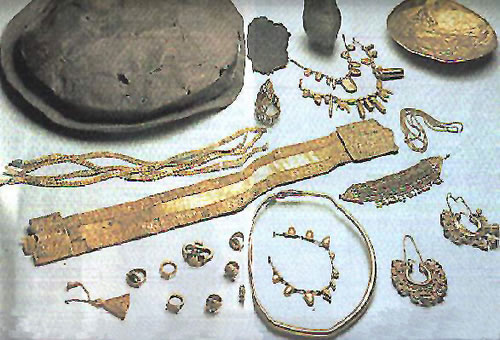
   En la última etapa de la Prehistoria, hace aproximadamente, 6.000 años, los hombres aprendieron a fabricar objetos de metal.

   Primero emplearon el cobre, más tarde el bronce y, posteriormente, el hierro.
 
    Con estos metales hacían armas, como espadas, hachas, lanzas; adornos, como collares y broches; y herramientas como azadas y hoces.

   Estas armas y herramientas, fabricadas con metal, eran más fuertes y resistentes que las fabricadas con piedra.

LAS CIUDADES

   En las zonas donde se encontraban estos metales se desarrollaron pequeñas ciudades, rodeadas de murallas de piedra para defenderlas.

   Comienzan a organizarse socialmente, en torno a un jefe y aparecen nuevos oficios: guerreros para defender la ciudad, comerciantes que compraban y vendían metales, tejidos, cerámica, etc.

INVENTOS DE LA EDAD DE LOS METALES

    En la Edad de los Metales se produjeron tres grandes inventos: la rueda, la vela y el arado.

   La rueda permitió trasladar mercancías más pesadas en carros.

El arado, arrastrado por animales, permitía labrar cultivos cada vez más extensos.
   La vela, lo que hizo posible construir barcos más grandes que podían transportar a más personas y más mercancías.

LOS MONUMENTOS MEGALÍTICOS
 
   Las personas que vivieron en esta época construyeron monumentos con grandes piedras llamadas megalitos.

   Hay diferentes clases de monumentos megalíticos, que puedes ver si pinchas en el siguiente enlace:

http://chopo.pntic.mec.es/~csanch20/PREHISTORIA/page7.html

   También puedes ver estos vídeos, sobre la Edad de los Metales y sobre los monumentos megalíticos.
 

FORCES and MACHINES - Questions and Answers

1. What is a force?

A force is any pull or push that can put an object into motion, stop an object or change the way that it moves. A force can also deform or break an object.

2. What are the main types of forces?  Give examples.

The main types of forces are contact forces and non-contact forces.

Contact forces act on objects by making physical contact, for example, a tennis player shots the ball with his tennis racket.

Non-contact forces act on objects without making physical contact, for example, a magnet attracting iron from a distance.

3. What type of force is magnetism?

The force of magnetism is a non-contact force.

4. What is the force of gravity? What does it depend on?

The force of gravity is a non-contact force that depends on an object’s mass and its distance from the Earth.

5. How do mass and distance affect the force of gravity?

Gravity is stronger on objects that have got more mass and on objects that are near the Earth.

6. Why do astronauts float in space?

Astronauts float on space because gravity is weaker on objects that are far from the Earth.

7. What is a machine?

A machine is a tool that multiplies force to make work faster and easier.

8. What is a simple machine?

A simple machine is a machine that usually has got one or two parts.

9. What is a complex machine?

Complex machines are combinations of two or more simple machines. They have got many parts.

10. In what everyday machines can we find gears?

We can find gears in clocks, bicycles and door handles.

11. What are the main types of simple machines?    

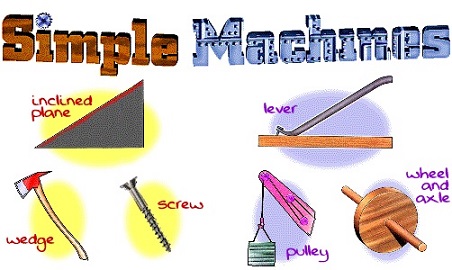
The main types of simple machines are: the wheel, the pulley, the ramp, the lever and the screw.

12. How can we use a pulley?

We use pulleys to lift loads. When we pull down on one end of the rope the other end pulls up the load. We use the same amount of force, but the pulley makes the work more comfortable.

13. How can we use a ramp?

We use a ramp to go up and down. We can also use a ramp to move heavy loads more easily.

14. How can we use a lever?

We use levers to move and lift objects more easily.

15. How do we call the fixed point of a lever?

We call it fulcrum.

16. Let’s see how much you know about your bicycle: What is the part that connects the crank to the back wheel? What do you use to change the direction of the front wheel? What is the special wheel with metal gears? What does a cable to control the brake pull?

The part that connects the crank to the back wheel is the chain.

The part that we use to change the direction of the front wheel is the handlebar.

The special wheel with metal gears is the crank.

The cable to control the brake pulls the brake lever.

17. What is technology? What does it include?

Technology is the art of applying scientific knowledge to solve practical problems. It includes designing and building the necessary equipment.

18. What is the most important invention in the history of transport?

The most important invention in the history of transport is the wheel.

19. What type of engine have most aeroplanes got today?

Most aeroplanes use the jet turbine.

20. What did the steam engine give us?

The steam machine gave us a new way to power machines and vehicles.

FORCES and MACHINES - Questions

  1. What is a force?
  2. What are the main types of forces?  Give examples.
  3. What type of force is magnetism?
  4. What is the force of gravity? What does it depend on?
  5. How do mass and distance affect the force of gravity?
  6. Why do astronauts float in space?
  7. What is a machine?
  8. What is a simple machine?
  9. What is a complex machine?
  10. In what everyday machines can we find gears?
  11. What are the main types of simple machines?    
  12. How can we use a pulley?
  13. How can we use a ramp?
  14. How can we use a lever?
  15. How do we call the fixed point of a lever?
  16. Let’s see how much you know about your bicycle: What is the part that connects the crank to the back wheel? What do you use to change the direction of the front wheel? What is the special wheel with metal gears? What does a cable to control the brake pull?
  17. What is technology? What does it include?
  18. What is the most important invention in the history of transport?
  19. What type of engine have most aeroplanes got today?
  20. What did the steam engine give us?

MORE GAMES ABOUT SIMPLE MACHINES


SIMPLE MACHINES GAME

Fancy playing a game on SIMPLE MACHINES while learning a bit more about them?

Click on the picture to start.

MORE ABOUT SIMPLE MACHINES

MORE ABOUT SIMPLE MACHINES

ANATOMY OF A GADGET-CAN YOU IDENTIFY THE SIMPLE MACHINE AT WORK? TEST YOURSELF HERE

SIMPLE MACHINES AND MORE

LEONARDO DA VINCI’S MYSTERY MACHINES GAME

MIKIDS-SIMPLE MACHINES


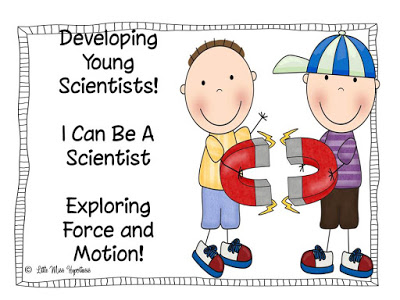
Force and Motion Facts

Force and Motion Facts

Motion makes the world go 'round. Motion is important to our lives and impacts so many things that we do. Motion is the changing of position or location. But motion requires a force to cause that change. 

Force is just a fancy word for pushing or pulling. If I push on something or pull on it, then I am applying a force to it. Force makes things move or, more accurately, makes things change their motion. Two natural forces that we have experienced are the force of gravity and magnetic forces.

Carry on learning about force and motion by clicking here....

Experiment

Experiment

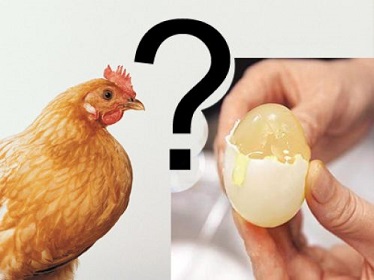
By placing an egg in a bowl containing vinegar, we can observe changes in its physical properties. Through this home experiment we'll try to explain in more detail each of the physical changes (color, smell, texture, etc.), as well as possible changes in chemical structure (decomposition).

Click here to learn about the experiment...


Physical & Chemical Changes

Physical & Chemical Changes

MATTER CHANGES - Questions

  1. What is matter?

  2. What does the state of matter depend on?

  3. What is the difference between physical changes and chemical changes of matter?

  4. How do we call the physical changes that matter undergoes when it changes from one physical state to another because of a change of temperature? Draw the diagram.

  5. What is a pure substance? What is a mixture? What is a solution?

  6. What is the difference between a homogeneous mixture and a heterogeneous mixture? Give examples.

  7. What is oxidation? And combustion?

  8. What techniques would you use to separate a mixture of oil and water, a mixture of sand and water, a mixture of salt and water, and to separate a mixture of iron and sand?

  9. It’s very cold and you are talking outside. Why does white vapour come out of your mouth? Is this a chemical change or physical change?

  10. Lets see what you know about water: Is it a pure substance or a mixture? Is it a simple substance or a compound? Why? What is its boiling point?


Solid, liquid and gas

Chemical and Physical Changes

Physical and Chemical Properties of Matter

Each phase of matter has its own chemical and physical properties.

Phases of Matter

The phases of matter are:

  • Solid – which has a definite shape and volume
  • Liquid – which has a definite volume, but can change shape
  • Gas - the shape and volume of a gas can change

Phase Changes of Matter

There are several ways in which phases of matter can change from one to another:

  • Melting - melting occurs when a substance changes from a solid to a liquid
  • Boiling - boiling is when a substance changes from a liquid to a gas
  • Condensing - condensation is when a gas changes to a liquid
  • Freezing - freezing is when a liquid changes to a solid

Classes of Changes in Matter

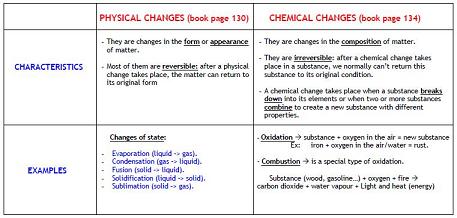
The changes that take place in substances may be categorized in two classes:

  • Physical Change – a new substance is not produced and just the physical properties are changed. For example - phase changes, or crushing a can
  • Chemical Change – a new substance is produced with different chemical properties. For example: burning, rusting, and photosynthesis.

Solutions

Sometimes, when two or more substances are combined it results in a solution. Making a solution can produce either a physical or chemical change. When there’s a physical change in a solution, the original substances can be separated from one another. If a chemical change takes place while creating a solution, the original substances cannot be separated from one another.

Atrévete con Europa...

Atrévete con Europa...

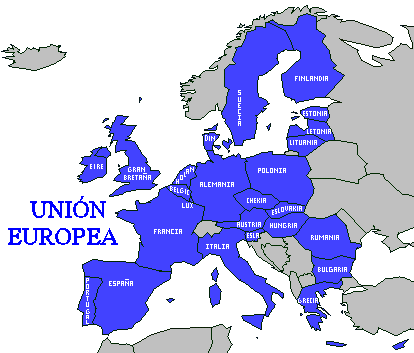
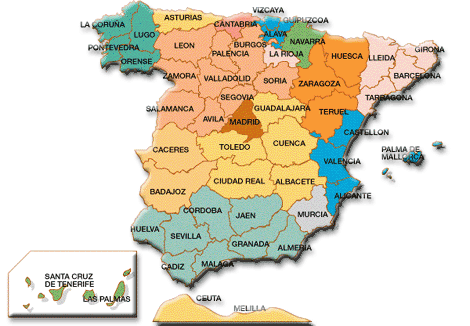
Si ya dominas la geografía española, atrévete con el mapa de Europa.

Pincha en el enlace para descubrir más juegos interactivos y aprender sobre Europa en su gran día.


Matter Matters!!

Matter matters!!

Learn more about Matter in these Super Science Sites!!


MATTER - Questions and Answers

 1. What is matter?

Everything around you is matter; matter is the stuff around you.

 2. What are the general properties of matter? Define them.

The general properties of matter as mass and volume.

Mass is the amount of matter in a physical body.

Volume is the amount of space that a body occupies.

 3. What tools do we use to measure the general properties of matter?

We can measure the mass of a body with scales and weighing machines.

To measure the volume of a solid body we can put it into a beaker of water.

 4. Can two objects weigh the same but have a different form and volume? Explain it.

Yes, two objects that have a different form and volume can weigh the same if they have got the same mass.

 5. Why does a wet T-shirt weigh more than a dry one?

Because the mass of the T-shirt has water added to it.

 6. Why does a balloon deflate if you don’t tie a knot?

Because air tends to occupy the maximum space possible.

 7. Why does a silver ring sink in water?

Because the density of silver is greater that the density of water.

 8. What are other specific properties of matter? Define them and give examples.

Different types of matter have got specific properties that make them unique. These specific properties of matter are hardness and toughness, plasticity, ductility and elasticity, and conductivity.

Hardness is the ability to resist scratches and cuts. Diamond is a hard material and chalk is a soft one.

Toughness is the ability to resist breaking. Steel and granite are tough materials and glass and porcelain are fragile ones.

Plasticity is the ability to change shape without breaking. Plastic materials can we bend and fold easily.

Ductility is the ability to be stretched to make thin wires. Gold and silver are very ductile materials.

Elasticity is the ability to return to their original shape after we bend or stretch them. Rubber is a very elastic material.

Conductivity is the ability to conduct heat or electricity. Thermal conductors conduct heat easily, as many metals. Electrical conductors conduct electricity very easily, as cooper and gold. Thermal insulators are materials that don’t conduct heat very well, as wood. Electrical insulators are materials that don’t conduct electricity very well, as plastic and rubber.

 9. How do we call materials that break easily?

We call them fragile materials.

 10. Is gold an elastic material? Why?

No, it isn’t. Gold can not be bent or stretched and return to its original shape.

 11. Give examples of two good thermal conductors and two good electrical conductors?

Iron and aluminium are good thermal conductors. Steel and cooper are good electrical conductors.

 12. How do we call materials that are not good conductors?

We call them insulators.

 13. Write two examples for each of the following definitions:

  • A hard, tough material: diamond

  • A soft, elastic material: sponge

  • A hard, fragile material: porcelain

  • A plastic, insulating material: rubber

 14. What are the three states of matter? And their properties?

The three states of matter are solid, liquid and gas.

Solids have a constant mass, a constant volume and a stable shape.

Liquids have a constant mass, a constant volume and a variable shape.

Gases have a constant mass, a variable volume and a variable shape.

 15. Which properties of solids are constant?

Mass, volume and shape are constant in solids.

 16. What are the three examples of water in a solid form?

Ice, snow and hail are three examples of water in a solid form.

 17. What does the state of water depend on?

The state of water depends on its temperature.

 18. How can we cause a change of state in water?

We can cause a change of state in water by adding heat.

 19. At what temperatures does water freezes and boils?

Water freezes at 0ºC and it boils at 100ºC.

 20. Look at the drawing on page 125 of your textbook and explain what happens:

There is ice in a glass beaker which is being heated. The ice melts because of the heat and changes to liquid water. As we continue heating the beaker, the water boils and changes to water vapour.

MATTER - Questions

  1. What is matter?
  2. What are the general properties of matter? Define them.
  3. What tools do we use to measure the general properties of matter?
  4. Can two objects weigh the same but have a different form and volume? Explain it.
  5. Why does a wet T-shirt weigh more than a dry one?
  6. Why does a balloon deflate if you don’t tie a knot?
  7. Why does a silver ring sink in water?
  8. What are other specific properties of matter? Define them and give examples.
  9. How do we call materials that break easily?
  10. Is gold an elastic material? Why?
  11. Give examples of two good thermal conductors and two good electrical conductors.
  12. How do we call materials that are not good conductors?
  13. Write two examples for each of the following definitions: a hard, tough material; a soft, elastic material; a hard fragile material; a plastic, insulating material.
  14. What are the three states of matter? And their properties?
  15. Which properties of solids are constant?
  16. What are the three examples of water in a solid form?
  17. What does the state of water depend on?
  18. How can we cause a change of state in water?
  19. At what temperatures does water freezes and boils?
  20. Look at the drawing on page 125 of your text book and explain what happens.

Más mapas interactivos

Vuestra compañera Lara (5ºA) nos recomienda otra página web con juegos para prácticar la geografía de España.

¡¡Gracias Lara!!

Mapas Interactivos

Pincha en el mapa para acceder a los mapas interactivos.

An Awesome song about the States of Matter!!!