ENGLISH
Present Continuous
FORM
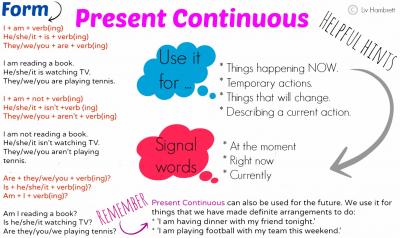
[am/is/are + verb-ING]
Examples:
- You are watching TV.
- Are you watching TV?
- You are not watching TV.
USE 1 Now

Use the Present Continuous with Normal Verbs to express the idea that something is happening now, at this very moment. It can also be used to show that something is not happening now.
Examples:
- You are learning English now.
- You are not swimming now.
- Are you sleeping?
- I am sitting.
- I am not standing.
- Is he sitting or standing?
- They are reading their books.
- They are not watching television.
- What are you doing?
- Why aren’t you doing your homework?
USE 2 Longer Actions in Progress Now

In English, "now" can mean: this second, today, this month, this year, this century, and so on. Sometimes, we use the Present Continuous to say that we are in the process of doing a longer action which is in progress; however, we might not be doing it at this exact second.
Examples: (All of these sentences can be said while eating dinner in a restaurant.)
- I am studying to become a doctor.
- I am not studying to become a dentist.
- I am reading the book Tom Sawyer.
- I am not reading any books right now.
- Are you working on any special projects at work?
- Aren’t you teaching at the university now?
USE 3 Near Future

Sometimes, speakers use the Present Continuous to indicate that something will or will not happen in the near future.
Examples:
- I am meeting some friends after work.
- I am not going to the party tonight.
- Is he visiting his parents next weekend?
- Isn’t he coming with us tonight?
USE 4 Repetition and Irritation with "Always"

The Present Continuous with words such as "always" or "constantly" expresses the idea that something irritating or shocking often happens. Notice that the meaning is like Simple Present, but with negative emotion. Remember to put the words "always" or "constantly" between "be" and "verb+ing."
Examples:
- She is always coming to class late.
- He is constantly talking. I wish he would shut up.
- I don’t like them because they are always complaining.
REMEMBER Non-Continuous Verbs/ Mixed Verbs
It is important to remember that Non-Continuous Verbs cannot be used in any continuous tenses. Also, certain non-continuous meanings for Mixed Verbs cannot be used in continuous tenses. Instead of using Present Continuous with these verbs, you must use Simple Present.
Examples:
- She is loving this chocolate ice cream. Not Correct
- She loves this chocolate ice cream. Correct
ADVERB PLACEMENT
The examples below show the placement for grammar adverbs such as: always, only, never, ever, still, just, etc.
Examples:
- You are still watching TV.
- Are you still watching TV?
ACTIVE / PASSIVE
Examples:
- Right now, Tom is writing the letter. Active
- Right now, the letter is being written by Tom. Passive
EXERCISES AND RELATED TOPICS
- Verb Tense Exercise 1 Simple Present and Present Continuous
- Verb Tense Exercise 2 Simple Present and Present Continuous
- Verb Tense Exercise 9 Present Continuous and Present Perfect Continuous
- Verb Tense Exercise 10 Present Continuous and Present Perfect Continuous
- Verb Tense Exercise 15 Tenses with durations
- Verb Tense Exercise 16 Present and Past Tenses with Non-Continuous Verbs
- Verb Tense Exercise 17 Present and Past Tense Review
- Verb Tense Exercise 24 Simple Present, Simple Future, Present Continuous, and Future Continuous
- Verb Tense Practice Test Cumulative Verb Tense Review
- Verb Tense Final Test Cumulative Verb Tense Review
Past Simple
FORM
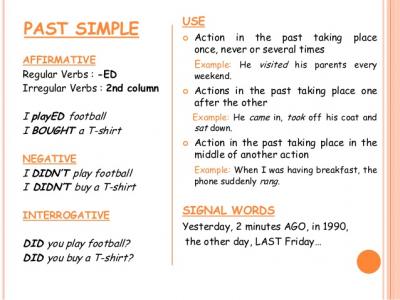
[VERB+ed] or irregular verbs
Examples:
- You called Debbie.
- Did you call Debbie?
- You did not call Debbie.
USE 1 Completed Action in the Past

Use the Simple Past to express the idea that an action started and finished at a specific time in the past. Sometimes, the speaker may not actually mention the specific time, but they do have one specific time in mind.
Examples:
- I saw a movie yesterday.
- I didn't see a play yesterday.
- Last year, I traveled to Japan.
- Last year, I didn't travel to Korea.
- Did you have dinner last night?
- She washed her car.
- He didn't wash his car.
USE 2 A Series of Completed Actions

We use the Simple Past to list a series of completed actions in the past. These actions happen 1st, 2nd, 3rd, 4th, and so on.
Examples:
- I finished work, walked to the beach, and found a nice place to swim.
- He arrived from the airport at 8:00, checked into the hotel at 9:00, and met the others at 10:00.
- Did you add flour, pour in the milk, and then add the eggs?
USE 3 Duration in Past

The Simple Past can be used with a duration which starts and stops in the past. A duration is a longer action often indicated by expressions such as: for two years, for five minutes, all day, all year, etc.
Examples:
- I lived in Brazil for two years.
- Shauna studied Japanese for five years.
- They sat at the beach all day.
- They did not stay at the party the entire time.
- We talked on the phone for thirty minutes.
- A: How long did you wait for them?
B: We waited for one hour.
USE 4 Habits in the Past

The Simple Past can also be used to describe a habit which stopped in the past. It can have the same meaning as "used to." To make it clear that we are talking about a habit, we often add expressions such as: always, often, usually, never, when I was a child, when I was younger, etc.
Examples:
- I studied French when I was a child.
- He played the violin.
- He didn't play the piano.
- Did you play a musical instrument when you were a kid?
- She worked at the movie theater after school.
- They never went to school, they always skipped class.
ADVERB PLACEMENT
The examples below show the placement for grammar adverbs such as: always, only, never, ever, still, just, etc.
Examples:
- You just called Debbie.
- Did you just call Debbie?
ACTIVE / PASSIVE
Examples:
- Tom repaired the car. Active
- The car was repaired by Tom. Passive
EXERCISES AND RELATED TOPICS
- Verb Tense Exercise 3 Simple Past and Past Continuous
- Verb Tense Exercise 4 Simple Past and Past Continuous
- Verb Tense Exercise 5 Simple Past and Present Perfect
- Verb Tense Exercise 6 Simple Past and Present Perfect
- Verb Tense Exercise 11 Simple Past and Past Perfect
- Verb Tense Exercise 12 Simple Past, Present Perfect, and Past Perfect
- Verb Tense Exercise 15 Tenses with durations
- Verb Tense Exercise 16 Present and Past Tenses with Non-Continuous Verbs
- Verb Tense Exercise 17 Present and Past Tense Review
- Verb Tense Practice Test Cumulative Verb Tense Review
- Verb Tense Final Test Cumulative Verb Tense Review
Present Simple
FORM
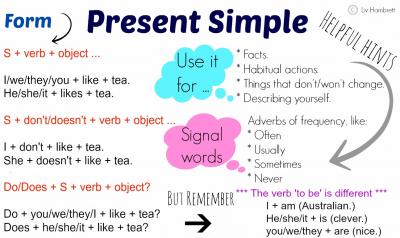
[VERB] + s/es in third person
Examples:
- You speak English.
- Do you speak English?
- You do not speak English.
USE 1 Repeated Actions
Use the Simple Present to express the idea that an action is repeated or usual. The action can be a habit, a hobby, a daily event, a scheduled event or something that often happens. It can also be something a person often forgets or usually does not do.
Examples:
- I play tennis.
- She does not play tennis.
- Does he play tennis?
- The train leaves every morning at 8 AM.
- The train does not leave at 9 AM.
- When does the train usually leave?
- She always forgets her purse.
- He never forgets his wallet.
- Every twelve months, the Earth circles the Sun.
- Does the Sun circle the Earth?
USE 2 Facts or Generalizations

The Simple Present can also indicate the speaker believes that a fact was true before, is true now, and will be true in the future. It is not important if the speaker is correct about the fact. It is also used to make generalizations about people or things.
Examples:
- Cats like milk.
- Birds do not like milk.
- Do pigs like milk?
- California is in America.
- California is not in the United Kingdom.
- Windows are made of glass.
- Windows are not made of wood.
- New York is a small city. It is not important that this fact is untrue.
USE 3 Scheduled Events in the Near Future
Speakers occasionally use Simple Present to talk about scheduled events in the near future. This is most commonly done when talking about public transportation, but it can be used with other scheduled events as well.
Examples:
- The train leaves tonight at 6 PM.
- The bus does not arrive at 11 AM, it arrives at 11 PM.
- When do we board the plane?
- The party starts at 8 o’clock.
- When does class begin tomorrow?
USE 4 Now (Non-Continuous Verbs)
Speakers sometimes use the Simple Present to express the idea that an action is happening or is not happening now. This can only be done with Non-Continuous Verbs and certain Mixed Verbs.
Examples:
- I am here now.
- She is not here now.
- He needs help right now.
- He does not need help now.
- He has his passport in his hand.
- Do you have your passport with you?
ADVERB PLACEMENT
The examples below show the placement for grammar adverbs such as: always, only, never, ever, still, just, etc.
Examples:
- You only speak English.
- Do you only speak English?
ACTIVE / PASSIVE
Examples:
- Once a week, Tom cleans the car. Active
- Once a week, the car is cleaned by Tom. Passive
EXERCISES AND RELATED TOPICS
- Verb Tense Exercise 1 Simple Present and Present Continuous
- Verb Tense Exercise 2 Simple Present and Present Continuous
- Verb Tense Exercise 16 Present and Past Tenses with Non-Continuous Verbs
- Verb Tense Exercise 17 Present and Past Tense Review
- Verb Tense Exercise 21 Simple Present and Simple Future
- Verb Tense Exercise 22 Simple Present and Simple Future
- Verb Tense Exercise 24 Simple Present, Simple Future, Present Continuous, and Future Continuous
- Verb Tense Practice Test Cumulative Verb Tense Review
- Verb Tense Final Test Cumulative Verb Tense Review
KET and PET online practice
Do you want to do more online practice?
KET or PET for schools?
Click on the picture and choose the appropriate level to do lots of extra practice online.

Example of KET for Schools SPEAKING TEST
PASSIVE VOICE
Use of Passive
Passive voice is used when the focus is on the action. It is not important or not known, however, who or what is performing the action.
Example: My bike was stolen.
In the example above, the focus is on the fact that my bike was stolen. I do not know, however, who did it.
Sometimes a statement in passive is more polite than active voice, as the following example shows:
Example: A mistake was made.
In this case, I focus on the fact that a mistake was made, but I do not blame anyone (e.g. You have made a mistake.).
Form of Passive
Subject + finite form of to be + Past Participle (3rd column of irregular verbs)
Example: A letter was written.
When rewriting active sentences in passive voice, note the following:
- the object of the active sentence becomes the subject of the passive sentence
- the finite form of the verb is changed (to be + past participle)
- the subject of the active sentence becomes the object of the passive sentence (or is dropped)
Examples of Passive 
| Tense | Subject | Verb | Object | |
|---|---|---|---|---|
| Simple Present | Active: | Rita | writes | a letter. |
| Passive: | A letter | is written | by Rita. | |
| Simple Past | Active: | Rita | wrote | a letter. |
| Passive: | A letter | was written | by Rita. | |
| Present Perfect | Active: | Rita | has written | a letter. |
| Passive: | A letter | has been written | by Rita. | |
| Future I | Active: | Rita | will write | a letter. |
| Passive: | A letter | will be written | by Rita. | |
| Hilfsverben | Active: | Rita | can write | a letter. |
| Passive: | A letter | can be written | by Rita. | |
Examples of Passive 
| Tense | Subject | Verb | Object | |
|---|---|---|---|---|
| Present Progressive | Active: | Rita | is writing | a letter. |
| Passive: | A letter | is being written | by Rita. | |
| Past Progressive | Active: | Rita | was writing | a letter. |
| Passive: | A letter | was being written | by Rita. | |
| Past Perfect | Active: | Rita | had written | a letter. |
| Passive: | A letter | had been written | by Rita. | |
| Future II | Active: | Rita | will have written | a letter. |
| Passive: | A letter | will have been written | by Rita. | |
| Conditional I | Active: | Rita | would write | a letter. |
| Passive: | A letter | would be written | by Rita. | |
| Conditional II | Active: | Rita | would have written | a letter. |
| Passive: | A letter | would have been written | by Rita. | |
Passive Sentences with Two Objects 
Rewriting an active sentence with two objects in passive voice means that one of the two objects becomes the subject, the other one remains an object. Which object to transform into a subject depends on what you want to put the focus on.
| Subject | Verb | Object 1 | Object 2 | |
|---|---|---|---|---|
| Active: | Rita | wrote | a letter | to me. |
| Passive: | A letter | was written | to me | by Rita. |
| Passive: | I | was written | a letter | by Rita. |
As you can see in the examples, adding by Rita does not sound very elegant. That’s why it is usually dropped.
Personal and Impersonal Passive
Personal Passive simply means that the object of the active sentence becomes the subject of the passive sentence. So every verb that needs an object (transitive verb) can form a personal passive.
Example: They build houses. – Houses are built.
Verbs without an object (intransitive verb) normally cannot form a personal passive sentence (as there is no object that can become the subject of the passive sentence). If you want to use an intransitive verb in passive voice, you need an impersonal construction – therefore this passive is called Impersonal Passive.
Example: he says – it is said
Impersonal Passive is not as common in English as in some other languages (e.g. German, Latin). In English, Impersonal Passive is only possible with verbs of perception (e. g. say, think, know).
Example: They say that women live longer than men. – It is said that women live longer than men.
Although Impersonal Passive is possible here, Personal Passive is more common.
Example: They say that women live longer than men. – Women are said to live longer than men.
The subject of the subordinate clause (women) goes to the beginning of the sentence; the verb of perception is put into passive voice. The rest of the sentence is added using an infinitive construction with ’to’ (certain auxiliary verbs and that are dropped).
Sometimes the term Personal Passive is used in English lessons if the indirect object of an active sentence is to become the subject of the passive sentence.
Exercises
Exercises on Passive (Form)
Exercises on Passive (Active → Passive)
- Exercise on Passive with Simple Present
- Exercise on Passive with Simple Past
- Exercise on Passive with Present Progressive
- Exercise on Passive with Past Progressive
Exercises on Passive (Active or Passive)
Tests on Passive
Writing Task 4
Friday, 14th November 2014
Correspondence
An American film company is making a film in your area next month and they are looking for extras. Write a letter to the film company explaining why you want to be an extra and saying why you might be suitable. Ask for more information about the film.
Writing Task 3
Friday, 7th November 2014
Correspondence
You have just won a large sum of money in a lottery. Write an email to your best friend to tell him or her the good news. Explain how you are planning to spend the money and ask your friend what he / she thinks of your ideas.
TONGUE TWISTER
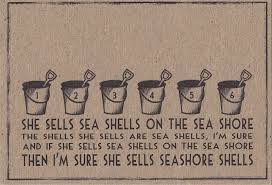
She sells sea shells
She sells sea shells on the sea shore;
The shells that she sells are sea shells I’m sure.
So if she sells sea shells on the sea shore,
I’m sure that the shells are sea shore shells.
QUESTION TAGS
We use tags in spoken English but not in formal written English.
They are not really questions but are a way of asking the other person to make a comment and so keep the conversation open.
Making a tag is very mechanical. To make a tag, use the first auxiliary. If there is no auxiliary, use do, does or did. With a positive sentence, make a negative tag and with a negative sentence, make a positive tag.
- It’s beautiful, isn’t it?
- He has been, hasn’t he?
- You can, can’t you?
- It must be, mustn’t it?
- You know him, don’t you?
- He finished it, didn’t he?
- He will come, won’t he?
- It isn’t very good, is it?
- It hasn’t rained, has it?
- It can’t be, can it?
- Jenny doesn’t know James, does she?
- They didn’t leave, did they?
- He won’t do it, will he?
Notice these:
- There isn’t an ATM here, is there?
- Let’s have a cup of coffee, shall we?
To reply, use the same auxiliary:
- It’s beautiful, isn’t it? ~ Yes, it is. I think it’s fabulous.
- It isn’t very good, is it? ~ No, it isn’t. In fact, it’s terrible.
Although, the rules are very simple and mechanical, in order to use them easily in conversation, they have to be automatic. So you need to hear and practice them very often.
COUNT ON ME by Bruno Mars
1st conditional
IF + SUBJECT + PRESENT SIMPLE, SUBJECT + WILL + INFINITIVE
SUBJECT + WILL + INFINITIVE + IF + SUBJECT + PRESENT SIMPLE
We use the First Conditional to talk about future events that are likely to happen.
- If we take John, he’ll be really pleased.
- If you give me some money, I’ll pay you back tomorrow.
- If they tell us they want it, we’ll have to give it to them.
- If Mary comes, she’ll want to drive.
The ’if’ clause can be used with different present forms.
- If I go to New York again, I’ll buy you a souvenir from the Empire State Building.
- If he’s feeling better, he’ll come.
- If she hasn’t heard the bad news yet, I’ll tell her.
The "future clause" can contain ’going to’ or the future perfect as well as ’will’.
- If I see him, I’m going to tell him exactly how angry I am.
- If we don’t get the contract, we’ll have wasted a lot of time and money.
The "future clause" can also contain other modal verbs such as ’can’ and ’must’.
- If you go to New York, you must have the cheesecake in Lindy’s.
- If he comes, you can get a lift home with him.
IF YOU ....
Don’t forget to write a story similar to these ones, starting:
"If you give a caterpillar a chocolate bar" (5ºA)
"If you give a snake a microphone"(5ºB)
"If you give a fish a bow tie" (5ºC)
Do not forget to use the first conditional to make your sentences.
Be creative!
Be original!
And have fun!!
GOING TO
Use
1) planned actions in the future
We are going to sing at the party.
2) You are certain that sth. is going to happen in the future.
Look at that car! It is going to crash into the yellow one.
Form
to be (am, are, is) + going to + infinitive
Affirmative sentences:
| I am going to play handball. I’m going to play handball. | You are going to play handball. You’re going to play handball. |
Negative sentences:
| I am not going to play handball. I’m not going to play handball. | You are not going to play handball. You’re not going to play handball. You aren’t going to play handball. |
Questions:
| Am I going to play handball? | Are you going to play handball?
|
ATTENTION!!
Do not mix up with the Present Continuous!
| going to-future | Present Continuous |
|---|---|
| He’s going to read the book. | He’s reading the book. |
You'll be in my heart
Writing Task
THE ADVENTURES OF HUCKLEBERRY FINN
What is your favourite part of the book?
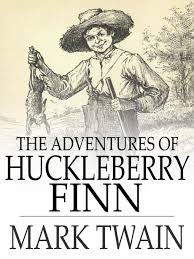
Click on the picture to learn a bit more about the book.
FUTURE
Simple Future
Simple Future has two different forms in English: "will" and "be going to." Although the two forms can sometimes be used interchangeably, they often express two very different meanings. These different meanings might seem too abstract at first, but with time and practice, the differences will become clear. Both "will" and "be going to" refer to a specific time in the future.

FORM Will
[will + verb]
Examples:
- You will help him later.
- Will you help him later?
- You will not help him later.
FORM Be Going To
[am/is/are + going to + verb]
Examples:
- You are going to meet Jane tonight.
- Are you going to meet Jane tonight?
- You are not going to meet Jane tonight.
Complete List of Simple Future Forms
USE 1 "Will" to Express a Voluntary Action
"Will" often suggests that a speaker will do something voluntarily. A voluntary action is one the speaker offers to do for someone else. Often, we use "will" to respond to someone else’s complaint or request for help. We also use "will" when we request that someone help us or volunteer to do something for us. Similarly, we use "will not" or "won’t" when we refuse to voluntarily do something.
Examples:
- I will send you the information when I get it.
- I will translate the email, so Mr. Smith can read it.
- Will you help me move this heavy table?
- Will you make dinner?
- I will not do your homework for you.
- I won’t do all the housework myself!
- A: I’m really hungry.
B: I’ll make some sandwiches. - A: I’m so tired. I’m about to fall asleep.
B: I’ll get you some coffee. - A: The phone is ringing.
B: I’ll get it.
USE 2 "Will" to Express a Promise
"Will" is usually used in promises.
Examples:
- I will call you when I arrive.
- If I am elected President of the United States, I will make sure everyone has access to inexpensive health insurance.
- I promise I will not tell him about the surprise party.
- Don’t worry, I’ll be careful.
- I won’t tell anyone your secret.
USE 3 "Be going to" to Express a Plan
"Be going to" expresses that something is a plan. It expresses the idea that a person intends to do something in the future. It does not matter whether the plan is realistic or not.
Examples:
- He is going to spend his vacation in Hawaii.
- She is not going to spend her vacation in Hawaii.
- A: When are we going to meet each other tonight?
B: We are going to meet at 6 PM. - I’m going to be an actor when I grow up.
- Michelle is going to begin medical school next year.
- They are going to drive all the way to Alaska.
- Who are you going to invite to the party?
- A: Who is going to make John’s birthday cake?
B: Sue is going to make John’s birthday cake.
USE 4 "Will" or "Be Going to" to Express a Prediction
Both "will" and "be going to" can express the idea of a general prediction about the future. Predictions are guesses about what might happen in the future. In "prediction" sentences, the subject usually has little control over the future and therefore USES 1-3 do not apply. In the following examples, there is no difference in meaning.
Examples:
- The year 2222 will be a very interesting year.
- The year 2222 is going to be a very interesting year.
- John Smith will be the next President.
- John Smith is going to be the next President.
- The movie "Zenith" will win several Academy Awards.
- The movie "Zenith" is going to win several Academy Awards.
Present Continuous
FORM
[am/is/are + present participle]
Examples:
- You are watching TV.
- Are you watching TV?
- You are not watching TV.
Complete List of Present Continuous Forms
USE 1 Now

Use the Present Continuous to express the idea that something is happening now, at this very moment. It can also be used to show that something is not happening now.
Examples:
- You are learning English now.
- You are not swimming now.
- Are you sleeping?
- I am sitting.
- I am not standing.
- Is he sitting or standing?
- They are reading their books.
- They are not watching television.
- What are you doing?
- Why aren’t you doing your homework?
USE 2 Longer Actions in Progress Now

In English, "now" can mean: this second, today, this month, this year, this century, and so on. Sometimes, we use the Present Continuous to say that we are in the process of doing a longer action which is in progress; however, we might not be doing it at this exact second.
Examples: (All of these sentences can be said while eating dinner in a restaurant.)
- I am studying to become a doctor.
- I am not studying to become a dentist.
- I am reading the book Tom Sawyer.
- I am not reading any books right now.
- Are you working on any special projects at work?
- Aren’t you teaching at the university now?
USE 3 Near Future
Sometimes, speakers use the Present Continuous to indicate that something will or will not happen in the near future.
Examples:
- I am meeting some friends after work.
- I am not going to the party tonight.
- Is he visiting his parents next weekend?
- Isn’t he coming with us tonight?
Exercises
- Verb Tense Exercise 1 Will and Be Going to
- Verb Tense Exercise 2 Will and Be Going to
- Verb Tense Exercise 3 Will and Be Going to
- Verb Tense Exercise 4 Simple Present and Present Continuous
- Verb Tense Exercise 5 Simple Present and Present Continuous
PRESENT PERFECT
 Present Perfect Verb Tense
1. Present Perfect - Form
The present perfect of any verb is composed of two elements : the appropriate form of the auxiliary verb to have (present tense), plus the past participle of the main verb. The past participle of a regular verb is base+ed, e.g. played, arrived, looked.
| Affirmative | ||
Subject | to have | past participle |
She | has | visited |
| Negative | ||
Subject | to have + not | past participle |
She | hasn’t | visited |
| Interrogative | ||
to have | subject | past participle |
Has | she | visited..? |
| Interrogative negative | ||
| to have + not | subject | past participle |
| Hasn’t | she | visited...? |
Example: to walk, present perfect
| Affirmative | Negative | Interrogative |
I have walked | I haven’t walked | Have I walked? |
You have walked | You haven’t walked | Have you walked? |
He, she, it has walked | He, she, it hasn’t walked | Has he,she,it walked |
We have walked | We haven’t walked | Have we walked? |
You have walked | You haven’t walked | Have you walked? |
They have walked | They haven’t walked | Have they walked? |
2. Present perfect, function
The Present Perfect is used to indicate a link between the present and the past. The time of the action is before now but not specified, and we are often more interested in the resultthan in the action itself.
BE CAREFUL! There may be a verb tense in your language with a similar form, but the meaning is probably NOT the same.
The Present Perfect is used to describe:
- An action or situation that started in the past and continues in the present. Example: I have lived in Bristol since 1984 (= and I still do.)
- An action performed during a period that has not yet finished. Example: She has been to the cinema twice this week (= and the week isn’t over yet.)
- A repeated action in an unspecified period between the past and now. Example: We have visited Portugal several times.
- An action that was completed in the very recent past, (expressed by ’just’). Example: I have just finished my work.
- An action when the time is not important. Example: He has read ’War and Peace’. (the result of his reading is important)
Note: When we want to give or ask details about when, where, who, we use the simple past. Example: He read ’War and Peace’ last week.
Examples:
1. Actions started in the past and continuing in the present.
- They haven’t lived here for years.
- She has worked in the bank for five years.
- We have had the same car for ten years.
- Have you played the piano since you were a child?
2. When the time period referred to has not finished.
- I have worked hard this week.
- It has rained a lot this year.
- We haven’t seen her today.
3. Actions repeated in an unspecified period between the past and now.
- They have seen that film six times.
- It has happened several times already.
- She has visited them frequently.
- We have eaten at that restaurant many times.
4. Actions completed in the very recent past (+just).
- Have you just finished work?
- I have just eaten.
- We have just seen her.
- Has he just left?
5. When the precise time of the action is not important or not known.
- Someone has eaten my soup!
- Have you seen ’Gone with the Wind’?
- She’s studied Japanese, Russian and English.
SIMPLE PAST vs PRESENT PERFECT
Simple Past | Present Perfect Simple |
|---|---|
Irregular verbs: see 2nd column of irregular verbs Example: I spoke | Irregular verbs: have/has + 3rd column of irregular verbs Example: I / you / we / they have spoken.he / she / it has spoken |
Regular verbs: have/has + infinitive + ed Example: I / you / we / they have workedhe / she / it has worked
| |
Exceptions when adding ’ed’:
| |
Use
In British English, the use of Simple Past and Present Perfect is quite strict. As soon as a time expression in the past is given, you have to use Simple Past. If there are no signal words, you must decide if we just talk about an action in the past or if its consequence in the present is important.
Certain time in the past or just / already /yet?
Do you want to express that an action happened at a certain time in the past (even if it was just a few seconds ago) or that an action has just /already / not yet happened?
| Simple Past | Present Perfect Simple |
|---|---|
certain time in the past Example: I phoned Mary 2 minutes ago. | just / already / not yet Example: I have just phoned Mary. |
Certain event in the past or how often so far?
Do you want to express when a certain action took place or whether / how often an action has happened till now?
| Simple Past | Present Perfect Simple |
|---|---|
certain event in the past Example: He went to Canada last summer. | whether / how often till now Example: Have you ever been to Canada? I have been to Canada twice. |
Emphasis on action or result?
Do you just want to express what happened in the past? Or do you want to emphasise the result (a past action’s consequence in the present)?
| Simple Past | Present Perfect Simple |
|---|---|
Emphasis on action Example: I bought a new bike. (just telling what I did in the past.) | Emphasis on result Example: I have bought a new bike. (with this sentence I actually want to express that I have a new bike now.) |
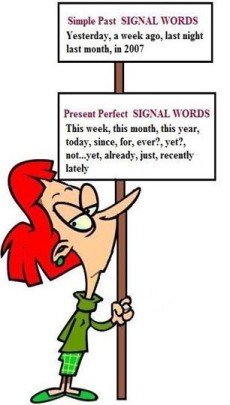
Signal Words
| Simple Past | Present Perfect Simple |
|---|---|
|
|
Exercises:
- Certain time in the past or just / already / yet: Exercise 1, Exercise 2
- Certain event in the past or how often so far: : Exercise 3, Exercise 4
- Emphasis on action or result: Exercise 5, Exercise 6
- Mix: Exercise 7, Exercise 8
Test