LIFE CYCLE OF A FROG
EASTER 2012

WHAT IS EASTER ?
Easter is the celebration of Jesus Christ’s rising from the dead (His Resurrection) after His crucifixion which took place on what we now term Good Friday.
Easter is usually celebrated on the first Sunday after the full moon following the Vernal or Spring Equinox on March 21st. This can be any Sunday between March 22nd and April 25th. It is the most sacred of all the Christian holidays or celebrations.
WHAT IS LENT?
Lent is the forty days special season prior to Easter Sunday. Sundays are not counted because it is the Lord’s Day and should be celebrated and therefore no fasting. Lent is a period of fasting or doing without certain foods, praying and repentance. This is to serve as a reminder of the forty days Jesus fasted in the wilderness. Some countries have celebrations like the Mardi Gras, which means "Fat Tuesday" in French, the day before Lent. It is also called "Carnival" sometimes.
WHAT IS THE HOLY WEEK ?
The Holy week is the last week of Lent. It begins with the observance of Palm Sunday, the Sunday before Easter Sunday. The name, Palm Sunday originated from Jesus’s entry in Jerusalem. The crowd laid carpets of palms on the street for Him. The Last Supper is commemorated on Holy Thursday of special week (often called Maundy Thursday) and Friday is the anniversary of the crucifixion of Jesus Christ on the cross. The Lenten season and Holy week end with Easter Sunday (the Resurrection of Jesus Christ).
NAMES OF EASTER
Easter was called Pesach by early Christians. It is the Hebrew name for Passover. Today, the name for Easter in many cultures in Europe are similar to the word Pesah. For example :
France -Paques
Spain -Pascua
Italy -Pasqua
Albania -Pashke
Greece -Pascha
Norway -Paaske
Holland -Pasen
Sweden -Pask
 |
What makes a mammal a mammal, or a bird a bird? Click on the buttons to learn more!
 |  |
 |  |
 |  |
 |  |
 |  |
 |  |

Learn more about special topics that separate the different kinds of animals!
 |  |
 |
 | ||
|



Test yourself with the Classification Game!
AMPHIBIANS

What is an amphibian?
An amphibian is an animal that lives part of its life in the water and part on land. Many amphibians begin life with gills to breathe in the water and then develop lungs as they get older.
What are the stages of the frog’s life cycle?
Eggs: Frogs lay thousands of eggs that do not have shells. They are covered with a jelly-like substance that helps protect them from being eaten by creatures in the water. The eggs stick together to form frog-spawn that floats to the top of the water. A few days later the tadpoles hatch out.

Tadpoles: Tadpoles have a head, tail and body. They live under water and breathe through their gills. They eat algae and other tiny water plants as they swim. After about a month, a bulge appears at the base of their tail where their hind legs will grow. They also begin to grow lungs for breathing.

Tadpoles to Froglets: After seven weeks their hind legs begin to grow. After nine weeks, front lets grow and their tails are almost gone. After about twelve weeks the tadpoles can swim to the surface of the water and breathe in air.

Adult Frogs: After about three months, the tadpoles have become young frogs. They can live in or out of water and eat insects or worms.

Click the thumbnail below to see a picture of the frog life cycle.


Activities:
 Something Froggy - Put the pictures in the correct order on this website.
 Frog Life Cycle Match - Put the pictures in order. Write a sentence to go with each stage. (Inspiration template)Life Cycle Picture - Draw a picture of the frog life cycle. (KidPix template)Interactive Quiz - Take this online quiz to see how much you’ve learned about frogs!
VERTEBRATES
SPRING!!!

Spring is the season between winter and summer.
It’s the time of year when life begins again in nature. In the Northern Hemisphere, spring begins on the day the center of the sun is directly over the equator. Usually, on March 20th, the sun crosses the equator and starts northward. As it travels north, its rays strike the northern countries more directly each day. Spring lasts until June 20 or 21.
In the Southern Hemisphere, spring begins in September and ends in December. Spring begins a few hours earlier in Leap Year.
19 de Marzo 2012 - BICENTENARIO DE LA PEPA
17th March: SAINT PATRICK'S DAY

St. Patrick is the patron saint of Ireland and St. Patrick’s Day falls on 17th March. Although originally a Catholic celebration, it has become more and more secular with parades, music and songs both in Ireland and in countries to which the Irish have emigrated.
This is a selection of website we have selected for you. Happy surfing!!
History.com - St. Patrick’s Day
Kaboose - St. Patty’s Day for Kids
INVERTEBRATES
101 Aniversario del nacimiento de AKIRA YOSHIZAWA
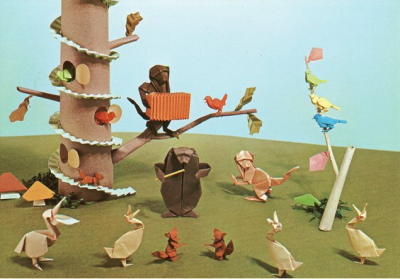
Akira Yoshizawa (Tochigi, 14 de Marzo de 1911 - 14 de marzo de 2005) es un maestro del origami japonés. Sexto hijo de una familia de campesinos. Yoshizawa es el único artista que ha intensificado el nivel de creación en origami.
Si te gusta el origami, visita esta página ORIGAMI MANIACS.
What is reported speech?
Reported speech is when you tell somebody else what you or a person said before.
Distinction must be made between direct speech and reported speech.
Direct speech vs Reported speech:
| Direct speech | Reported speech |
|---|---|
| She says:" she likes tuna fish." | She says that she likes tuna fish. |
| She said: "I’m visiting Paris next weekend" | She said that she was visiting Paris the following weekend. |
Different types of sentences
When you use reported speech, you either report:
- Statements
- questions
- requests / commands
- other types
I. Reporting Statements
When transforming statements, check whether you have to change:
- pronouns
- tense
- place and time expression
1-Pronouns
In reported speech, you often have to change the pronoun depending on who says what.
Example:
She says, “My dad likes roast chicken.” – She says that her dad likes roast chicken.
2-Tenses
- If the sentence starts in the present, there is no backshift of tenses in Reported speech.
- If the sentence starts in the past, there is often backshift of tenses in Reported speech.
| Direct speech | Reported speech | |
|---|---|---|
| (no backshift) | “I write poems.” | He says that he writes poems. |
| (backshift) | “I write poems.” | He said that he wrote poems. |
No backshift
Do not change the tense if the introductory clause is in a present tense (e. g. He says). Note, however, that you might have to change the form of the present tense verb (3rd person singular).
Example:
He says, “I write poems.” – He says that he writes English.
Backshift
You must change the tense if the introductory clause is in a past tense (e. g. He said).
Example:
He said, “I am happy.” – He said that he was happy.
Examples of the main changes in tense:
| Direct Speech | Reported Speech |
|---|---|
Simple Present He said: "I am happy" | Simple Past He said that he was happy |
Present Progressive He said: "I’m looking for my keys" | Past Progressive He said that he was looking for his keys |
3-Pronouns, place and time expressions
Place and time expressions change if the context of the reported statement (ie the location and/or the period of time) is different from that of the direct speech.
In the following tables, you will find ways of transforming personal pronouns, place and time expressions into reported speech.
Changes in Personal Pronouns:
| I | he, she |
| you | he, she, they |
| we | they |
| they | they |
| he, she | he, she, I |
Changes in Possessive Pronouns:
| my | his, her, my |
| your | his, her, my |
| his, her | his, her |
| their | their |
| our, | their |
| here | there |
| this | that |
| these | those |
here, there | at the George Hotel, at school |
| last year, last month, last week | the year/month/week before |
| yesterday, the day before yesterday | the day before, two days before |
| today | that day, yesterday, the day before |
| tomorrow | the next day |
| the day after tomorrow | in two days |
| next week/month/year | the following week/month/year |
| on Monday | on Monday, 11th December |
| this morning / afternoon / evening/night | that morning / afternoon / evening/ night |
| last week, month, year | the previous week, month, year |
| three days, weeks, months, ...years ago | three days, weeks, months, .....years before |
Examples of the main changes in tense:
| Direct Speech | Reported Speech |
|---|---|
Simple Present He said: "I am happy" | Simple Past He said that he was happy |
Present Progressive He said: "I’m looking for my keys" | Past Progressive He said that he was looking for his keys |
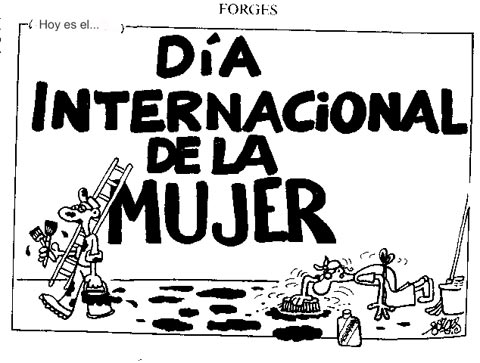
TEATRO DE SOMBRAS EN MADRID

SPELLING PRACTICE

Click on the image to have some extra Spelling Practice.
Armies of Trash People Invade the World's Cities!
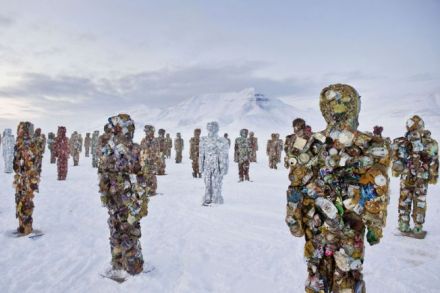
HA Schult’s "Trash People" rank worldwide among the first environmental artworks, ...
Click here to see pictures of Trash People in cities all around the world.
2012, LEAP YEAR!!
Fun cool facts about Leap Year Day February 29
OK, let’s learn how to say it correctly.
Someone born on February 29 was born on Leap Day,
or Leap Year Day. They were NOT born ON Leap Year.
Leap Year is the year we are in; like 2012 or 2016.
Anyone can be born IN a Leap Year. Leap Year lasts
all year. Leap Day Babies were born ON Leap Day.
THAT is what is rare. In fact, the odds are 1 in 1461!
You don’t have to be born on February 29 to enjoy Leap Day.
|It’s everyone’s extra day!
28 DAYS HAS FEBRUARY
Twenty-eight days has February
A very light load for one month to carry
The other months have 2 and 3 more
Thirty and thirty-one being their big score
In Leap Years the days they do vary
Making 29 days in February
| WHAT DO LEAP DAY BABIES CALL THEMSELVES? We are Leap Day babies, |  |
If you want to carry on reading, click here.
| IF YOU ARE A LEAP DAY BABY... You will hear the same questions for the rest of your life! 1. When do you celebrate? Number 3 - Of course we get a birthday. We age, we The question they are really asking is: What is it like to have a birthday that’s Just explain to them that you do "get" a birthday. Just Let them know what it feels like to you. Be honest. Sometimes, when they know what it’s all about, they |  |
 | IF I WAS BORN ON LEAP DAY, HOW OLD AM I REALLY? When speaking of your Leap-age, it is incorrect to say you are 2 "years" old when you are really 8 "years" old. You are 2 LEAP Years old. Or - even better, just simply 2. When talking about a friend or relative born on Leap Day And watch the facial expressions change. Don’t say "5 ’years’ old" that doesn’t make sense. BUT, stopping at the number has a bigger impact. I was born in 1960, but I turned 12 this last Leap |
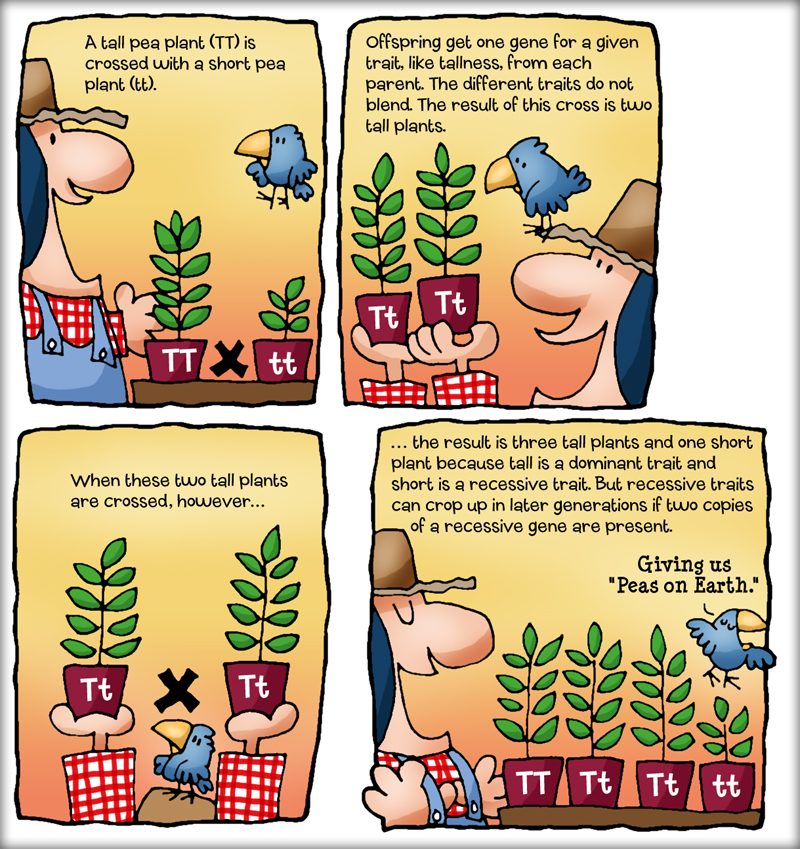
Gregor Mendels Pea Plants
Austrian monk and avid Gardener Gregor Mendel is credited for discovering why tall plants (in his case, pea) don’t always produce tall offspring, nor do smaller plants.