Blogia

Our 6th grade Blog

22 de abril: DÍA DE LA TIERRA
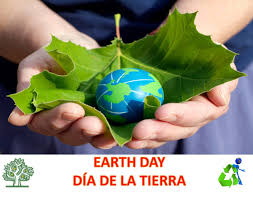
22 de abril: DÍA DE LA TIERRA

Hoy la Madre Tierra es protagonista. Este martes 22 de abril se celebra el Día de la Tierra.

El 22 de abril de 1970 el político y activista ambiental Gaylord Nelson propuso la creación de una agencia medioambiental y su petición no cayó en saco roto. Se creó la Environmental Protection Agency (Agencia de Protección Ambiental) y una serie de leyes destinada a la protección del medio ambiente. Por eso cada 22 de abril se celebra en muchos países el Día Internacional de la Tierra.

El senador estadounidense luchó para que el mundo entero se concience de los problemas de la naturaleza, la contaminación y la necesidad de mantener la biodiversidad.

Este año, el Día de la Madre Tierra se centrará en las ciudades verdes, con el objetivo de movilizar a millones de personas para lograr un medio ambiente saludable y sostenible. «En la actualidad, más de la mitad de la población mundial vive en las ciudades. A medida que la población urbana crece y los efectos del cambio climático empeoran, nuestras ciudades deben evolucionar», según explica la ONU.

BrainPOP Jr. GAMES

Do you want to learn and play while reviewing science?

I’m sure you do.

Visit this website to have fun learning: Brain POP Jr GAMES

VERTEBRATES - Questions

  1. What are the main characteristics of vertebrates?
  2. How do some vertebrates take oxygen from water?
  3. How do viviparous animals reproduce?
  4. How many groups of vertebrates are there?
  5. What covers the body of an amphibian?
  6. How do most fish reproduce?
  7. What is a shark’s skeleton made of?
  8. What are two names for amphibian young?
  9. Why haven’t adult frogs got tails?
  10. How do snakes move around?
  11. Are lizards viviparous animals?
  12. Which reptile has got a hard shell?
  13. What have birds and turtles got instead of teeth?
  14. How can we classify mammals according to the way they reproduce? Give examples of mammals belonging to each group.
  15. What do mammary glands do?
  16. Which mammals reproduce by laying eggs?
  17. Which group of mammals is the most numerous?
  18. Where do female marsupials carry their young?
  19. According to what they eat, animals can be carnivores, herbivores and omnivores. Give an example of each group.
  20. Can you name any fishing carnivore? And what about a hunting carnivore?

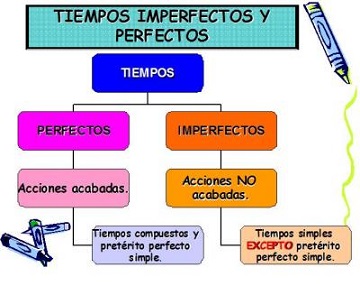
El verbo

El verbo from Flufla

Animal Groups

Almost all animals fall into one of two groups. Adultvertebrates have a spinal column, or backbone, running the length of the body; invertebrates do not. Vertebrates are often larger and have more complex bodies than invertebrates. However, there are many more invertebrates than vertebrates.

Vertebrates

  • Fish breathe through gills, and live in water; most are cold-blooded and lay eggs (although sharks give birth to live young).
  • Amphibians are cold-blooded and live both on land (breathing with lungs) and in water (breathing through gills) at different times. Three types of amphibians are frogs and toads, salamanders, and caecilians. Caecilians are primitive amphibians that resemble earthworms. They are found in the tropics.
  • Reptiles are cold-blooded and breathe with lungs. They have scales, and most lay eggs. Reptiles include snakes, turtles and tortoises, crocodiles and alligators, and lizards. Dinosaurs were reptiles, although some scientists believe that some were warm blooded.
  • Birds are warm-blooded animals with feathers and wings. They lay eggs, and most can fly (although many, including penguins and ostriches, cannot).
  • Mammals are warm-blooded, and are nourished by their mothers’ milk; most are born live (however, the platypus lays eggs). Most mammals also have body hair.

Invertebrates

  • Sponges are the most primitive of animal groups. They live in water (usually saltwater), are sessile (do not move from place to place), and filter tiny organisms out of the water for food.
  • Coelenterates (jellyfish and polyps) are also very primitive. Their mouths, which take in food and get rid of waste, are surrounded by stinging tentacles. Some coelenterates are jellyfish, corals, and sea anemones.
  • Echinoderms include starfish, sea urchins, and sea cucumbers. They live in seawater and have external skeletons.
  • Annelids or worms come in many varieties and live in all sorts of habitats — from the bottom of the ocean to the inside of other animals. They include flatworms (flukes), roundworms (hookworms), segmented worms (earthworms), and rotifers (philodina).
  • Mollusks are soft-bodied animals, which often live in hard shells. They include snails, slugs, octopus, squid, mussels, oysters, clams, scallops, chitons, and cuttlefish. Mollusks are the second-largest group of invertebrates, with 50,000 living species.
  • Arthropods are the largest and most diverse of all animal groups. They have segmented bodies supported by a hard external skeleton (or exoskeleton). Arthropods include insects, arachnids (spiders and their relatives), centipedes, millipedes, and crustaceans like crabs, lobsters, and shrimp.

... Learn more about vertebrates and invertebrates in BIOLOGY 4 KIDS.


OPERACIONES SEMANA DEL 7 AL 11 DE ABRIL DE 2.014

OPERACIONES SEMANA DEL 7 AL 11 DE ABRIL DE 2.014

FECHA: 7 DE ABRIL

38. 814 : 98     y         prueba

FECHA: 8 DE ABRIL

226.278  : 75    y     prueba

FECHA: 9 DE ABRIL

9 x (7 – 3) – 2 x (7 + 5)=

6 + 8 – (3 x 2)=

12 – 5 + 8 x 3=

FECHA:10 DE ABRIL

12% de 1.200=

¾ de 68=

874,325 : 1000=

6.857 x 100=

FECHA: 11 DE ABRIL

9.087,2 x 82 =      

5.465,65 - 3.214,235=

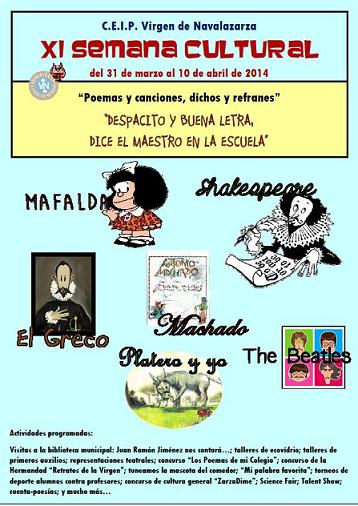
31 de marzo al 10 de abril: XI Semana Cultural

31 de marzo al 10 de abril: XI Semana Cultural

2nd April: TALENT SHOW

2nd April: TALENT SHOW

1st April: APRIL FOOLS DAY

1st April: APRIL FOOLS DAY

April Fools’ Day (sometimes called All Fools’ Day) is an informal holiday celebrated every year on April 1. It is not a national holiday, but is widely recognized and celebrated in various countries as a day when people play practical jokes and hoaxes on each other, called April fools. Hoax stories are also often found in the press and media on this day.

Precursors of April Fools’ Day include the Roman festival of Hilaria, held March 25, and the Medieval Feast of Fools, held December 28, still a day on which pranks are played in Spanish-speaking countries.

OPERACIONES SEMANA DEL 31 DE MARZO AL 4 DE ABRIL

OPERACIONES SEMANA DEL 31 DE MARZO AL 4 DE ABRIL


FECHA: 31 DE MARZO

15.527 : 23   y      Prueba


FECHA: 1 DE ABRIL

17.519 : 63   y      Prueba


FECHA: 2 DE ABRIL

42 + 4 x 3 – 5 x 7 =

5 x 4 – (16 – 12) x 2 =

28 – 5 x 4 + 16 =


FECHA: 3 DE ABRIL

88.386 : 25     y    Prueba

7.897,23 : 100=   

9876,56 x 1000=


FECHA: 4 DE ABRIL

1.768,24 x 34  =            

3.568,69 + 8.957,325=   

¡¡ZARZADIME!!!

¡¡ZARZADIME!!!

Repaso de preguntas de cultura general


OPERACIONES SEMANA DEL 24 AL 28 DE MARZO DE 2014

OPERACIONES SEMANA DEL 24 AL 28 DE MARZO DE 2014

FECHA: 24 DE MARZO

 32.221 : 39   y    Prueba


FECHA: 25 DE MARZO

   81.398 : 83   y  Prueba


FECHA: 26 DE MARZO

  4 x 3 + 2 x 5 – 6 x 3 =


  2 x (3 + 4) – 3 x (7 – 4) =


  24 - 6 + 2 x 10 =


FECHA: 27 DE MARZO

 26.516 :  47 y Prueba


 3.987 x 10 =                   

 789,25 : 100 =


FECHA: 28 DE MARZO

 3.369,5 x 65=         

 7.895,389 – 685,25=

INVERTEBRATES - Questions

  1. What are the main characteristics of invertebrates?
  2. What percentage of the world’s animals are vertebrates?
  3. What is the most numerous group of animals on our planet?
  4. What main groups of invertebrates are there?
  5. What kind of protection have ants and beetles got?
  6. What has an echinoderm got on its body?
  7. Which invertebrate has got a soft body with many segments?
  8. What main groups of arthropods are there?
  9. How many legs have the different groups of arthropods got?
  10. Which type of arthropod can have wings?
  11. What type of mollusk has got long arms?
  12. What is the shape of a snail’s shell?
  13. How do bivalve mollusks get nutrients?
  14. Are jellyfish filter feeders?
  15. How do polyps anchor themselves to the ocean floor?
  16. How many arms has a starfish normally got?
  17. What group of invertebrates do earthworms belong to?
  18. How do sponges feed?
  19. Why has a sea urchin got spikes on its body?
  20. Give examples of some arthropods that are useful for us and some that cause problems.

20 de marzo: PRIMER DÍA DE LA PRIMAVERA 2014

20 de marzo: PRIMER DÍA DE LA PRIMAVERA 2014

Inicio astronómico de la primavera de 2014

Según cálculos del Observatorio Astronómico Nacional (Instituto Geográfico Nacional - Ministerio de Fomento), la primavera de 2014 comenzará el jueves 20 de marzo a las 17h 57m hora oficial peninsular, a las 16h 57m en Canarias. Esta estación durará 92 días y 18 horas, y terminará el 21 de junio con el comienzo del verano.

Durante esta primavera se producirán dos eclipses, uno total de Luna (15 de abril) y dos semanas después uno anular de Sol (29 de abril), el primero de ellos será visible en España. En cuanto a los planetas, Marte pasará de ser visible muy brillante toda la noche durante la primera parte de la primavera a ser visible sólo en el cielo vespertino, mientras tanto Saturno pasará de ser visible al final de la noche durante la primera parte de la primavera a verse toda la noche en el mes de mayo y terminará el final de la estación siendo visible en el cielo vespertino, produciéndose su máximo acercamiento anual a la Tierra a mediados de mayo. Durante toda la primavera Júpiter brillará al principio de la noche y Venus al final de la noche. Aunque difícil de predecir, la actividad magnética solar durante esta primavera será probablemente alta, dado que el máximo solar está previsto para abril de 2014.

Por otra parte, el domingo 30 de marzo tendrá lugar el cambio de hora, recuperando el horario de verano.

El inicio de la primavera

El inicio de las estaciones viene dado, por convenio, por aquellos instantes en que la Tierra se encuentra en unas determinadas posiciones en su órbita alrededor del Sol. En el caso de la primavera, esta posición es aquella en que el centro del Sol, visto desde la Tierra, cruza el ecuador celeste en su movimiento aparente hacia el norte. Cuando esto sucede, la duración del día y la noche prácticamente coinciden, y por eso, a esta circunstancia se la llama también equinoccio de primavera. En este instante en el hemisferio sur se inicia el otoño.


19th March: FATHER'S DAY

19th March: FATHER'S DAY

Father’s DayEl Día del Padre, is observed on the Feast day of Saint Joseph, which is March 19. It is celebrated as a public holiday in some regions of Spain.

Father’s Day is a celebration honoring fathers and celebrating fatherhood, paternal bonds, and the influence of fathers in society. Many countries celebrate it on the third Sunday of June, but it is also celebrated widely on other days. Father’s Day was created to complement Mother’s Day, a celebration that honors mothers and motherhood.


17th March: SAINT PATRICK'S DAY

17th March: SAINT PATRICK'S DAY

St. Patrick is the patron saint of Ireland and St. Patrick’s Day falls on 17th March. Although originally a Catholic celebration, it has become more and more secular with parades, music and songs both in Ireland and in countries to which the Irish have emigrated.

This is a selection of website we have selected for you. Happy surfing!!

St. Patrick’s Day

History.com - St. Patrick’s Day

Kaboose - St. Patty’s Day for Kids

Leprechauns


Research Project on Arthropods

Research Project on Arthropods

1.- How do we get honey from bees? Explain the process from beehive to table. Why is honey so good for us? What other products do we get from beehives?


2.- Which arthropods are edible? Which ones are eaten in Spain? Which ones are eaten in other countries? Look for recipes that have mollusks as the main ingredient.


3.- What is malaria? How is it transmitted? In what countries is malaria a severe problem? How many people are infected every year? Look for possible measures for prevention and cure.


4.- What are locusts? What type of animal are they? In which countries is there a danger of locusts destroying farmer’s crops? How fast can a swarm of locusts eat their way through a field of crops? What can be done to prevent this from happening?