Día 11





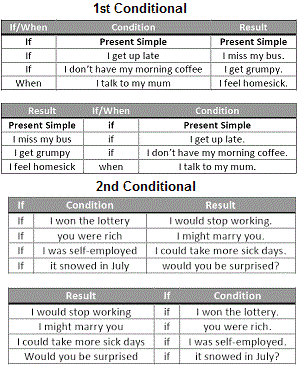
Conditional tenses describe the result of something that might happen (in the present or future) or might have happened but didn’t (in the past).

1st Conditional Tenses
IF + SUBJECT + PRESENT SIMPLE, SUBJECT + WILL + INFINITIVE
SUBJECT + WILL + INFINITIVE + IF + SUBJECT + PRESENT SIMPLE
We use the First Conditional to talk about future events that are likely to happen.
The "future clause" can contain ’going to’ or the future perfect as well as ’will’.
The "future clause" can also contain other modal verbs such as ’can’ and ’must’.
2nd Conditional
IF + SUBJECT + PAST SIMPLE, SUBJECT + WOULD+ INFINITIVE
SUBJECT + WOULD + INFINITIVE + IF + SUBJECT + PAST SIMPLE
The Second Conditional is used to talk about ’impossible’ situations.
After I / he/ she /it we often use the subjunctive form ’were’ and not ’was’. (Some people think that ’were’ is the only ’correct’ form but other people think ’was’ is equally ’correct’ .)
The form ’If I were you’ is often used to give advice.
The Second Conditional is also used to talk about ’unlikely’ situations.
The choice between the first and the second conditional is often a question of the speaker’s attitude rather than of facts. Compare these examples. Otto thinks these things are possible, Peter doesn’t.
The ’If clause’ can contain the past simple or the past continuous.
The main clause can contain ’would’ ’could’ or ’might.
Sometimes the ’if clause’ is implied rather than spoken.
Friday, 4th November 2016
Create a story (100 words) about a witch, a cat and a haunted house.
Your story should begin with: This is the witches first Halloween...
Friday, 21st October 2016
Write a story (100 words) about a time you went to a museum (if you have never visited a museum, make up a story).
In your story you have to include vocabulary words from Unit 1: paintings, background, sculptures, art gallery, portraits, mural and landscapes.